
Is Eternal Snow Really Eternal?

Written By Damien Brohon
Dzogchen Testimonials | Reflections on life
In “Is Eternal Snow Really Eternal?”, Damien invites us to reflect on the concept of eternity and the Great Perfection.
Series: Summer in the Mountains
Is Eternal Snow Really Eternal?
It has been found.
What? – Eternity.
It is the sea that has gone
With the sun.
Arthur Rimbaud
As a child, I was filled with a deep sense of wonder by the notion of ‘eternal snow’. What? The haughty summit of that mountain range that closes off the horizon is crowned with eternal snow? How? Would that snow shine endlessly with the same brilliance? Eh? So it would be like gods and goddesses overlooking us mere mortals down in the valley? This expression opened my mind to another dimension – beyond the human, transcendent and absolute. A feeling confirmed by the contemplation of immaculate whiteness. As if something of the mystery of existence were revealed through the sight of these inaccessible glaciers. A breath of eternity…
In the Tibetan tradition—that is, the cultural context within which the teachings of Dzogchen unfold in this world [1]—many mountains are regarded as the abodes of deities, guardian spirits (yul lha, ‘valley gods’) or sacred powers. Tibetans generally do not view them as mere geographical features, but rather as genuine, living presences. In Tibet, almost every valley thus has its own protective mountain. It watches over the inhabitants, livestock, crops and monasteries. Locals offer juniper incense, prayer flags and various other offerings to these mountains. To cite a few examples, one might of course mention Mount Kailash, which is associated with the tantric deity Khorlo Demchok (Cakrasaṃvara) and his consort Vajravārāhī. In the Bön tradition, this mountain is also linked to other primordial deities. On Amnyé Machèn, one of the holiest mountains in the eastern Tibetan Plateau, resides a powerful local protective deity in the form of a warrior on horseback. Nyenchen Tanglha refers to both a mountain range and an important territorial deity who resides there. These mountains do indeed appear to be strongholds of eternity. What we are dealing with here is a traditional worldview that perceives the invisible through the visible.
“… the ephemeral is the expression of the eternal.”
But for us – somewhat disenchanted postmodernists – is such an approach really possible? And, to begin with, is the eternal snow really eternal? Back when I was a child, an adult (they can be such a nuisance!) told me, “Yes, but you know, the eternal snows aren’t really eternal.” There is indeed scope to support this disillusioned view. Traditionally, “eternal snows” refers to snow that persists all year-round above a certain altitude. This limit varies depending on the climate. It is very high in tropical regions, lower in temperate regions and sometimes almost at sea level in polar regions. However, this snow is not permanent. Over the course of centuries or millennia, it advances and retreats in response to climatic variations. Today, global warming is causing a significant reduction in many areas of permanent snow and numerous glaciers in mountain ranges such as the Alps, the Andes and the Himalayas. The term “eternal snows” is more poetic than scientificaly accurate. It refers more to “snow that is permanently present under current climatic conditions” than to “snow destined to last forever”.
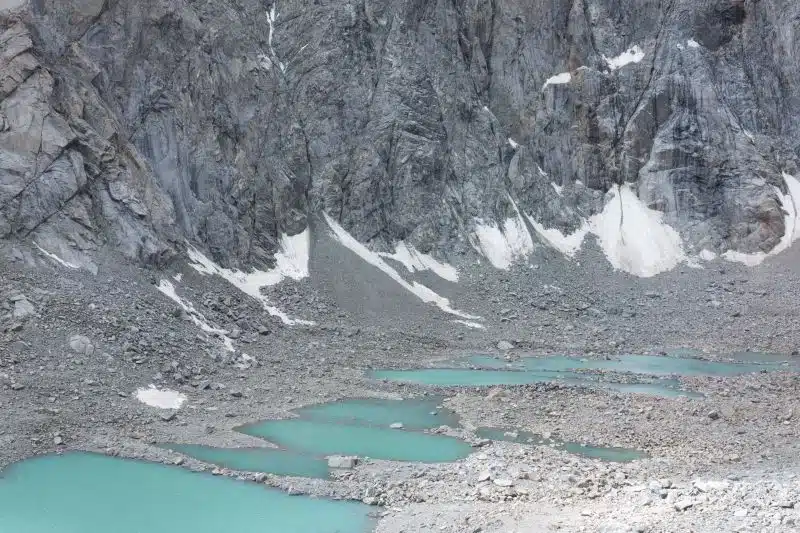
As temperatures rise, more snow melts during the warmer months. Consequently, the permanent snow line is graduallyshifting higher. Areas that were once covered in snow year-round may thus become rocky in summer. Furthermore, as glaciers are fed by snow accumulation, if more snow melts each summer than falls in winter, they shrink. In many mountainous regions, glaciers are thinning and retreating towards the summits, while other are disappearing completely. Finally, when the snow disappears, it reveals darker rocks or soil. These darker surfaces absorb more solar energy than white snow, which reflects light. In short, not only has this snow never been eternal, but it is becoming less and less so.
But does this mean, however, that there is nothing eternal that reveals itself when one contemplates the eternal snows? To answer this, we must first consider the meaning of the word ‘eternal’. Do we mean something that has neither a beginning nor an end, or something with infinite duration in the past (in Latin, a parte ante) or in the future (in Latin, a parte post)? From this perspective, the eternal snows are certainly not eternal… Because they are conditioned phenomena (as an analysis of their ecosystem shows), they can only be impermanent, as the Buddha’s teachings tell us. Reflection on conditioned co-arising—that is, the fact that nothing arises without multiple and ephemeral causes and conditions—leaves no room for doubt on this matter. Of course, the impermanence of the eternal snows echoes our own mortality. Everything we regard as solid – ourselves, others and our world – is in fact ephemeral. We seek to grasp what is ultimately ungraspable – wether it to be our identity or the beauty of the snow.
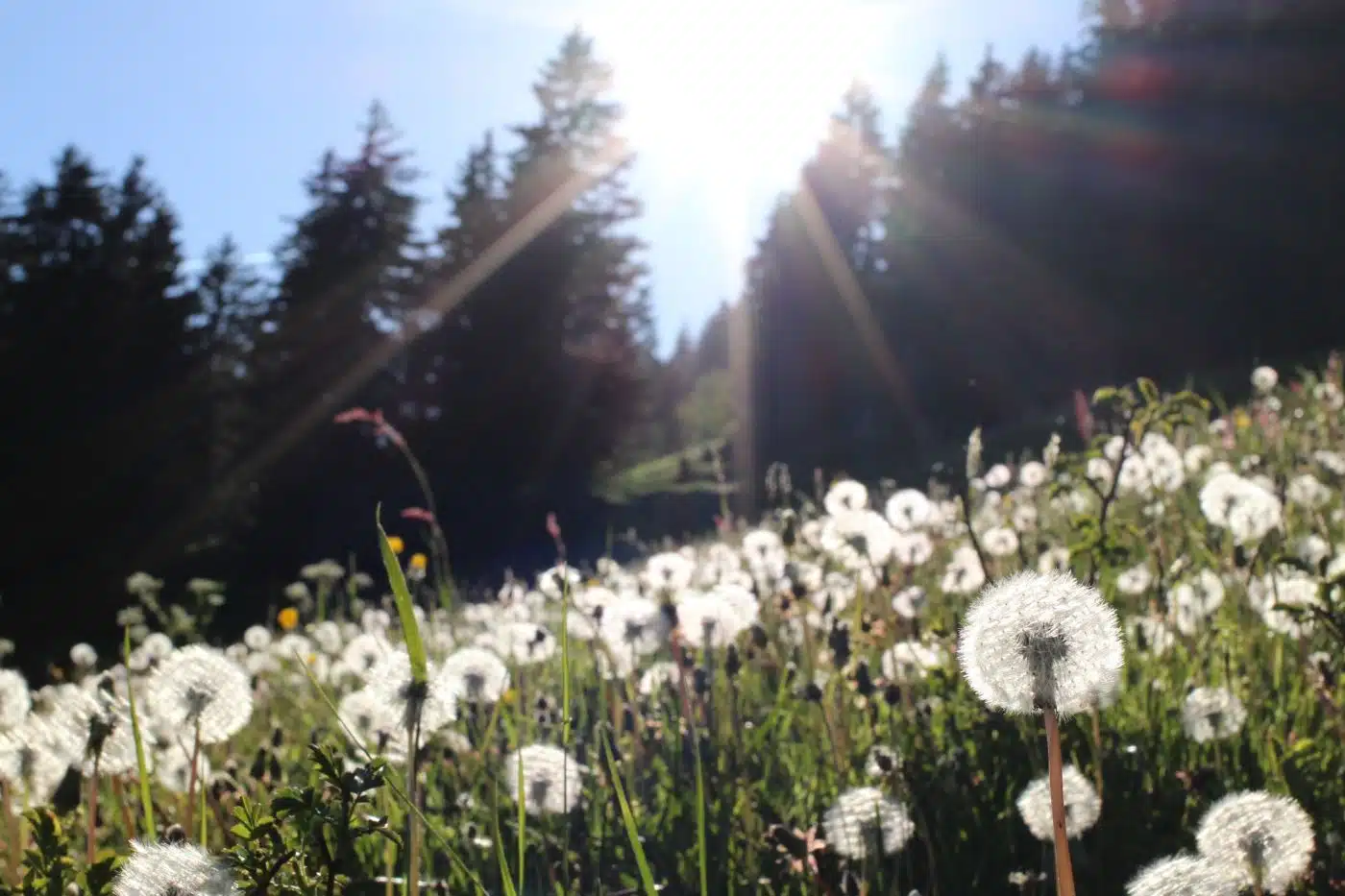
This is all the more true in light of global warming.
Dzogchen does not object to this. However Garab Dorje’s teaching would also say that phenomena are rgyan, that is to say, adornments. What does this mean? The nature of our mind consists of an empty essence whose expression is naturally clear and which manifests itself supremely in the form of the myriad appearances that make up our experience: rgyan, the ornaments. Indeed, here the term ‘eternity’ does not refer to the endless duration of a phenomenon, which would absurd, but rather to the fact that the nature of phenomena lies beyond time. Such is the nature of emptiness-luminousness. It is known as dus bzhi mnyam pa chenpo (pronounced düshi nyampa chenpo): the fourth time of great equality – wich is, the unchanging basis of the three times. The absolute is dynamic. The timeless nature of mind manifests through impermanent appearances. It is simply that these are perceived by the Dzogchen practitioner sub specie aeternitatis (Latin for ‘under the aspect of eternity’).
To put it another way, the ephemeral is the expression of the eternal.
We might borrow the Platonic phrase here: “Time is the moving image of eternity” [2]. The cat sleeping beside the computer is rgyan. The radio at the neighbours’ is rgyan. The sight of the eternal snows is rgyan. Their beauty and majesty interrupt the flow of ordinary thoughts. The sense of wonder it evokes offers a glimpse into the absolute. As stated in The Small Hidden Seeds [3]: “ In the experience of the profound absence of conceptualization, there is nothing but the experience itself. ” In such moments, the instant becomes eternity and eternity is wholly contained within the instant. Nothing to do, nowhere to go; everything is given. When we fall back into the anxious flow of the thinking mind, the memory of that moment of eternity may invite us to embark on a spiritual path to rediscover and fully realize what was but a fleeting glimpse.
A child gazes upon the eternal snows,
In his eyes, the luminous adornements of empty essence are reflected,
In his heart the realm beyond time blazes
[1] One of the thirteen universes (or solar system, literally ‘stardust’) where it is taught according to the Dra Tal Gyur (the Dzogchen Men ngag dé tantra). BACK
[2] In Timaeus 37d5. BACK
[3] Translated by the Dzogchen Today! translation committee. The full text can be found here: https://dzogchentoday.org/the-small-hidden-seeds/ BACK
More Posts
On The Mountain Trails
Maréva explores the perspectives of the hiker and the shepherd whose experiences oscillate between exertion and contemplation.
Starry Night
In “Starry Night,” Johanne, camping up in the mountains, talks about how skygazing reveals our own primordial nature…
The Wolf Family on Vacation
In this article, Grégoire draws parallels between the wolf and the Dzogchen practitioner, between solitude, community life, spiritual practice and everyday life.