
Crossing the Pass

Written By Maréva Bernard
Reflections on life | The Dzogchen Journey
Maréva explores the symbolism of crossing mountain passes in the Himalayas and in the West, and its connection to the practitioner’s path.
Series: Summer in the Mountains
Crossing the Pass?
I’m not much of an athlete, but on a hike, I have one stubborn obsession. Seeing what’s around the next bend, what’s waiting behind the ridge ahead. What if there’s a stunning view? Or what if there’s something else entirely?
There’s something magical about a mountain pass : without ever leaving the trail, you cross from one world into another. A few steps, and sometimes the whole scene can shift: a plateau opens up, a lush green valley appears, the terrain turns sharp, or you discover that the snow hasn’t melted here yet. Sometimes a small fear creeps in, not knowing what’s coming next. Will the path become hostile, or will it become easier ?
This fleeting feeling is the mark of an important place, an idea that is still very much alive in the Himalayas, but which was also known in the West in its own way.
“With each step, pass after pass, new stretches of knowledge open up, pulling us closer to higher knowledge.”
In our mountains, these spaces were sites of divine intercession. They were dangerous grounds where nature grew wilder and where the wind hit harder, where bandits could be lying in wait, and where travelers had to trust in something greater to see them through. People built shrines to local gods at these spots, which later became chapels, wayside crosses, and small oratories, partly for protection and partly to mark the place where two worlds met.
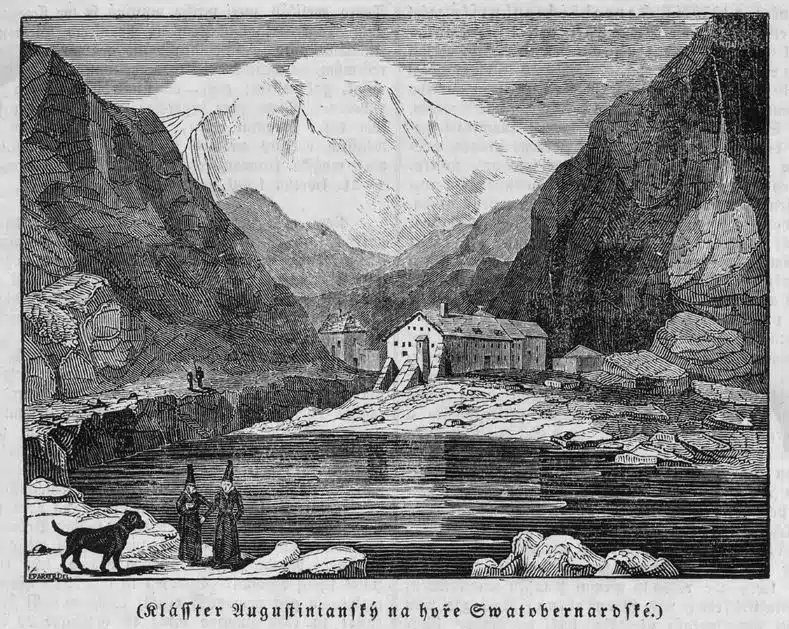
One of the best-known passes is the Great St Bernard, in Switzerland’s Valais region, on the Via Francigena, the route to Rome. The Romans built a temple to Jupiter there in antiquity. Centuries later, Bernard of Aosta, later canonized as Saint Bernard, founded a hospice on the same spot in the 9th century to shelter travelers. [1]
Turning to the east, Isabelle Sacareau writes in an academic paper on walking in the Himalayas, that “in Tibetan culture regions, high mountain passes are marked by chörten, cairns crowned with prayer flags where travelers leave a stone, a flower, or a scrap of cloth, to mark the gods’ victory over the demons, and to thank them for having allowed their passage” [2]. Even now, travelers mark the moment with a triumphant cry : “Kyi kyi so so lha gyal lo!” Because they’ve made it through the territory of the yulhas, the mountain gods Paul introduced in The mountain is alive 2.
Crossing a pass can also take on real spiritual weight, especially on a pilgrimage. It becomes a marker of transformation.
Crossing the “Drolma La” pass on the circumambulation route around Mount Kailash, Central Tibet’s holiest mountain, is one of the journey’s defining moments. It symbolizes the passage between two lives. Reaching the pass requires a long climb, typically beginning the day after a stopover at Drirapuk Monastery. The ascent of about 600 meters between 5,000 and 5,600 meters demands tremendous effort from the walker in such thin air.
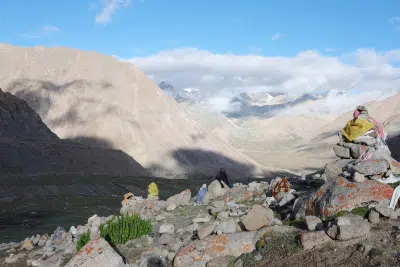
Along the way, pilgrims leave an item of clothing behind as a symbol of the negative deeds that are purified by the climb and by the blessing of Tara, the perfectly awakened one. At the top, pilgrims make smoke offerings, hang prayer flags, burn incense, and scatter prayer papers to the wind. In this way, they honor the local gods, offer prayers, and give thanks to the perfectly awakened ones. On the other side waits the Lake of Compassion followed by the descent. It’s a rebirth, a new journey beginning.
These outer paths mirror our inner path. With each step, pass after pass, new stretches of knowledge open up, pulling us closer to higher knowledge.
It’s transformation within continuity, the eye simply lands on a horizon that wasn’t visible before, though it has always been there, now unveiling itself. The path keeps going, it doesn’t break but everything looks different now.
And one day, we arrive at the summit. From up there, knowledge takes in everything, carried by the blessing of the perfectly awakened ones.
More Posts
The Story of the First Masters: Jnanasutra
The saga of the early masters of Dzogchen continues with Jñanasutra, who devoted his 500th and final life as a scholar to the practice of the Great Perfection and the attainment of the body of light.

Work as a Basis for Practice
In “Work as a Basis for Practice”, Mila Khyentse talks about working and practicing Dzogchen at the same time in the same place.
Manifestation
In this article, Paul defines manifestation as the play of emptiness of the All-Excellent free from partial grasping.