
The Wolf Family on Vacation

Written By Grégoire Langouet
Dzogchen practice | Mind and Dzogchen | Reflections on life
In this article, Grégoire draws parallels between the wolf and the Dzogchen practitioner, between solitude, community life, spiritual practice and everyday life.
Series: Summer in the Mountains
The Wolf Family on Vacation
Like Dzogchen practitioners, wolves love the mountains… and vacations. We often picture them enjoying the solitude of the great outdoors, retreats in caves, and the living silence of the night. Furthermore, like the solitary wolf, the Dzogchen yogin, may be feared by the people of the lowlands. After all, the wolf is often been portrayed as a dangerous, solitary animal. But this is far from the truth! In reality, they are mostly peaceful and sociable, just like the Dzogchen yogin or yoginī – well, not always…
Although the image of the lone wolf has struck fear into the hearts of Europeans since the Middle Ages, wolves actually live in packs and cooperates with their fellow pack members, forming close-knit family units. In a sense, they mirror groups of Buddhist and Dzogchen practitioners. The latter form the ‘community’ or saṅgha (Tib. ‘gendün’ ; dge ‘dun) – the maṇḍala (Tib. dkyil ‘khor) of the guru in the vocabulary of Vajrayāna Buddhism.
“So both wolves and practitioners must come to terms with communal life and all its joys and difficulties, especially on holiday, when the whole family lives together around the clock!”
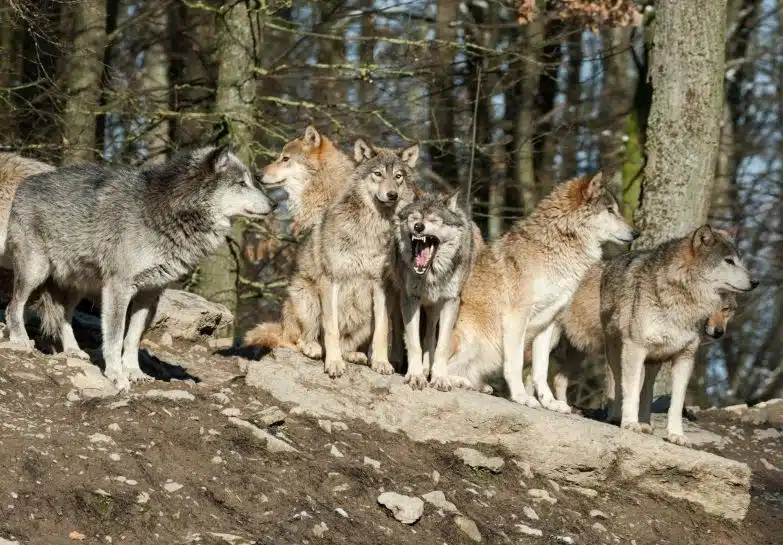
Thus, even though the supreme practice may seem to be that of solitary yogins and yoginīs, collective life appears to be the norm for most of us – a life shared within a community. Furthermore, the Dzogchen tradition asserts that it is necessary to practise within one’s ordinary circumstances, including one’s family and all its members, whether they are pleasant or difficult.
Aspiring Dzogchen practitioners, just like wolves, live with their fellow practitioners – in a pack, as a family – whether in everyday life or on holiday, in the mountains or in the forest. This entails all sorts of things: ‘Are we there yet, Dad?’, ‘I’m hungry!’, ‘Mum, Mum, look!’, ‘No, it’s mine – I don’t want to share!’. In this environment, it is a challenge to remember the nature of the mind without tension; and thus to act appropriately at all times; to maintain one’s concentration focused and open, and to keep one’s vision on the essential, on our very nature – on that which lies beyond all conditions, illusory and transitory.
So both wolves and practitioners must come to terms with communal life and all its joys and difficulties, especially on holiday, when the whole family lives together around the clock!
But what better ‘test’ is there than the distracting and chaotic daily routine of family activities on vacation, mirroring that of a wolf pack: searching for food, cooking, eating, washing, and looking after the young and old, etc.? This is a real check, a full-scale test of how firmly our spiritual practice is integrated into our daily lives.

For we must admit that it is not easy to maintain one’s formal practice under the right conditions, even on holiday. In other words, it is difficult to sustain the essential vision – the vision of the nature of reality as empty and luminous – and to recall and recognise it. The daily life of the family pack is therefore a test, a mirror of our capacity.
The wolf, like the yogin of Dzogchen, caught between fantasy and reality, between solitary freedom and community life, embodies a subtle balance to be discovered along the way. However, according to the radical vision of Dzogchen, this makes no difference whatsoever. Conditions are just the natural manifestations of primordial nature. Thus, whether alone or with family, in the mountains or by the sea, the original essence of reality will never have been affected. However, even so… between human and wolf… For Buddhist and Dzogchen traditions emphasize the preciousness of human life, a condition more desirable than that of a wolf, even on vacation, with the family, in the mountains! As for that of the werewolf – halfway between human and wolf – that is a whole other story. But that’s certainly a topic for another time!
More Posts
A Living Tradition: The Kama and Terma Lineages
In "A Living Tradition: The Kama and Terma Lineages", Denis introduces the two lineages of transmission central to the Nyingma tradition.
Nirvana
In this article, Damien defines nirvana, the definitive recognition of the nature of reality as manifested by the three Bodies.
Following a Master
Maréva elaborates on "Following a Master", the demands but also the obviousness of this path toward the realization of primordial nature.