
The ground of all Künshi

Written By Paul Baffier
Dzogchen Terms | The Dzogchen basics
This article “The ground of all, Künshi” provide a better understanding of the essential words and concepts of Dzogchen.
Series: The Dzogchen Terms
The ground of all, Künshi
The ground of all is called “künshi” (kun gzhi) in Tibetan and ālaya in Sanskrit. The Tibetan word “kün”, which means “everything,” conveys the idea of a whole, while ‘shi’ means “ground, base, foundation.”
The ground of all is the substrate of all potentialities [1] and the receptacle of all traces [2] for every possible experience: all existences, perceptions, thoughts, etc., are simultaneously recorded, produced, and preserved there. This functioning through “development” and “recording” perpetuates the illusion of continuity in our existences, which reproduce the same habitual patterns over and over again in a closed cycle.
The basis of everything is a neutral state usually associated with the foundation of the ordinary conditioned mind (“sèm”; sems) and its mental events. In this sense, it can be experienced in a conditioned way during meditative absorptions of the three dimensions of existence (desire, form, formless). This is not rig pa, the primordial evidence. The ground of all is therefore to be distinguished from the “primordial ground” (“yéshi”; ye gzhi The ground (gzhi) because they can be confused, hence the need for clarification on this point.

[1] “seeds,” in Tibetan “sabön”: sa bon. BACK
[2] “imprints,” in Tibetan “bakchak”: bag chags. BACK
Beware! In Bönpo Dzogchen, kun gzhi, “universal basis,” is equivalent to gzhi or ye gzhi in the Nyingma lineage.
Tibetan terms are given in parentheses: the first is the phonetic transcription and pronunciation in Lhasa, and the second is the Wylie transcription indicating the Tibetan spelling of the term. BACK
More Posts

The Great Perfection at Work?
In this article, Vincent explores the role of spiritual practice in the workplace and the question of whether the two are compatible.

Personal Branding: The Self in the Image
In this article, Grégoire explores whether we are our image and to what extent we can play with it to liberate ourselves.
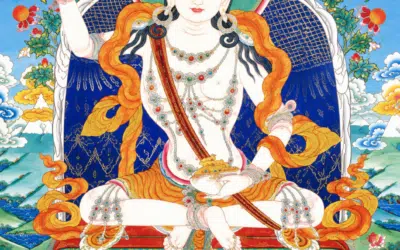
The Story of the First Masters: Jnanasutra
The saga of the early masters of Dzogchen continues with Jñanasutra, who devoted his 500th and final life as a scholar to the practice of the Great Perfection and the attainment of the body of light.