
The termas conditions

Written By Johanne Bernard
Culture and tradition | General Introduction to Dzogchen
In “The termas conditions,” Johanne talks about the convergence of all the necessary conditions for the termas discovery, application, and transmission..
Series: Highlighting the Terma Lineages
The termas conditions
Eighth century, Tibetan Empire. The Tibetan king Trisong Detsen invited Padmasambhava, a great Indian master also known by the Tibetan name Guru Rinpoche, to help spread Buddhism throughout his kingdom. Padmasambhava subdued the local deities who opposed this establishment and helped build the first Buddhist monastery at Samye alongside the abbot Shantarakshita. This marked the beginning of the Nyingma tradition of Tantric Buddhism in Tibet. The teachings quickly spread, and disciples flocked to the monastery. However, political and religious conditions were unstable. Some priests of the indigenous Bon tradition and conservative leaders protested, and power struggles created obstacles. As he leaves Tibet, Guru Rinpoche prophesies the near-future persecution of Buddhism. To ensure that the teachings would not disappear and that the essential instructions would not be altered, he hid his teachings in the form of termas. These teachings would be rediscovered intact by Tertöns, those destined to transmit them in the future.
Accompanied by his principal disciples, who help transcribe his teachings, Padmasambhava and his Tibetan mystical consort Yeshe Tsogyal—renowned for her infallible memory—work tirelessly: across Tibet, Nepal, Bhutan, and the Himalayan regions of India, they hide texts, sacred substances, ritual objects, and statues within the walls of monasteries, in the rocks of the mountains, in the waters of lakes, and even in the sky. In the minds of the disciples, Guru Rinpoche “plants” the teachings as spiritual seeds that will blossom in the future. An extraordinary mission, for the benefit of all beings. According to tradition, Yeshe Tsogyal continued it alone for nearly a hundred years after Guru Rinpoche departed for Chamaradvipa, the realm of the Rakshasas.
“Fulfilling all the conditions of the termas seems as rare as finding “a celestial star emerging from the earth” or “a precious jewel emerging from the sky.” Yet, through the power of aspiration and the blessing of the lineage, termas have reached us across the centuries. ”
How many termas – these “spiritual treasures”- have been hidden in this way? Surely as countless as the rays of compassion of Guru Rinpoche and Yeshe Tsogyal… How many will reach the beings for whom they are intended? The answer depends on the convergence of all the conditions necessary for their discovery, application, and transmission —conditions inherent to each terma and specified in prophetic guides that are sometimes hidden with these treasures.
These prophetic guides are true “roadmaps” for the tertön or tertönma to whom the terma is intended. Everything is recorded in precise detail and order: the appropriate time for discovery, the location associated with the terma, the presence of a mystical companion, the disciples for whom the terma is intended, and whether preparatory practices are to be performed.
First, the appropriate time, corresponds to the specific period in the future when the hidden teaching is meant to be transmitted and the terma is to be unearthed. It may be a specific year or even a specific month within that year. If it is too early or too late, not only will the “chest” containing the terma fail to open, but, like a seed that sprouts before ripening, the terma will be lost or reassigned to another tertön if the opportunity arises.
Next is the location associated with the terma. It is both the place where the terma is hidden, protected by the guardian deities to whom Guru Rinpoche and Yeshe Tsogyal entrusted its care, and the place where it is destined to be revealed. It may be a hidden valley, for example, and in this case, the conditions for its discovery will be linked to those required to enter the valley. It may be a place where the terma was placed to enhance the site’s vital energy and discovering it will require specific practices; or the terma may be intended for wider diffusion. Sometimes indicated in prophetic guides, the location may also appear to the tertön through visions or signs in dreams, like a seed sprouting in his mind of wisdom. Once the location has been revealed to the tertön, he must still have the conditions to travel there…
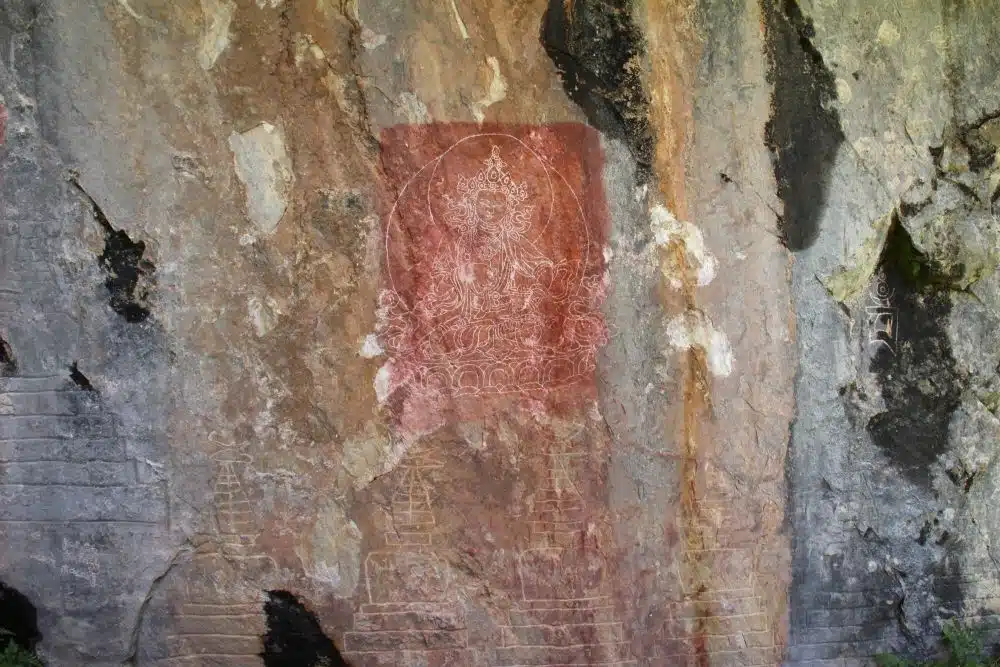
The presence of the khandroma or khandro (Tib. mkha’ ‘gro ma, mkha’ ‘gro Skt. ḍākiṇī, ḍāka) is the third and most essential condition in the process of discovering a terma, just as Yeshe Tsogyal’s presence was essential at the time of its concealment. This presence is essential because, on the one hand, it results from the wishes of Guru Rinpoche and Yeshe Tsogyal, and on the other hand because it is inherent in the procedure of the terma. If the terma emerges in the mind of the master, it is the dakini, who conceals the terma, who carries its meaning. Through the power of past wishes, the dakini or daka manifests once more as the tertön’s vehicle of activity, and enables the tertön, by her mere presence, to understand the meaning of the terma upon its discovery.
The khandroma or khandro, literally “she or he who moves through the sky”—the “physical space”—is thus, for the tertön, the enlightened being who enables the activity of the terma—that is, the possibility of its rediscovery, its unfolding, and its realization by the intented beings.
Sometimes the khandro or khandroma associated with the terma is unable to travel. In such cases, a mere token representing them, such as a lock of their hair or a piece of their clothing, may suffice. The importance of a “tangible” support of activity is an intrinsic condition of the nature of termas, which are intended for human beings and which enlightened activity unfolds through the five sense doors at the level of the nirmanakaya, the aspect of tangible reality.
The presence of the tertön and the khandroma is indispensable in the terma process, just as the union of wisdom and skillful means is in the realization of the nature of mind, of which they are in reality only a reflection. As Yeshe Tsogyal writes in her biography [1]: “The Guru and Dakini, mystic partners, having identical ambition, serve all being, with skillful means and perfect insight… (…) Ultimately, Pema Jungne and Yéshé Tsogyäl are identical to Kuntuzangpo and Kuntuzangmo (Kunzang yab yum) [2]: our Body, Speech, Mind, Activity, and Quality are co-extensive with all-pervasive space.”
Finally, the last condition concerns the disciples, for whom the terma transmission is intended. It may be an entire community, a small group of students, or even a single disciple, as in the case of a medicinal pill, for example. The intended recipients must be mature enough to receive, understand and practice the teaching, and they must be in circumstances that allow them to do so.
Sometimes preparatory practices are necessary to foster the right conditions. Assistance may also be sought from another tertön, as was the case with Chokgyur Lingpa in the 19th century, who sought the support of Jamyang Khyentse Wangpo, one of the five tertön kings, to decipher some texts. However, sometimes this is not enough. In such cases, if the terma has been discovered but the conditions for its application and transmission are not present, the tertön must conceal the terma once more and create the conditions so that it may be rediscovered later, as a “twice-revealed treasure.”
The conditions for uncovering earth termas are numerous and depend on external circumstances. These include the right time and place, the presence of the khandro or the khandroma and disciples, and more. If any one of these conditions is missing, the terma cannot be discovered. Then, even if all conditions are met, the tertön must be able to decipher the symbolic and coded writing, if it is a text, and put it into practice to realize its potential. Then, it must be authenticated by another tertön, often a great bodhisattva, before it can be transmitted… Do Khyentse Yeshe Dorje, a great Dzogchen master of the 19th century, said in his autobiography that since it was very difficult to fulfill all the conditions for earth termas, the “best” termas were those of the mind, less vulnerable to obstacles, where meaning and text appear simultaneously… Yet, the spiritual seed planted in the mind of the future tertön must still be able to sprout, and the teachings must arise within the nature of his mind…
Thus, fulfilling all the conditions of the termas seems as rare as finding “a celestial star emerging from the earth” or “a precious jewel emerging from the sky.” Yet, through the power of aspiration and the blessing of the lineage, termas have reached us across the centuries. We then realize that these teachings that have been transmitted to us, these texts that we hold in our hands and put into practice, are true treasures, whose radiance is that of luminous clarity, whose setting is the mind of the master in union with that of the disciple, and whose essence is the ultimate essence of the pure and perfect mind—that of the heart. With infinite gratitude, we once again express the wish that the termas, these spiritual treasures, continue to be discovered for the benefit of future generations and of all beings.
[1] Excerpt from Sky Dancer. The Secret Life and Songs of the Lady Yeshe Tsogyel, Keith Dowman, ed Snow Lion – pp.122-124. BACK
[2] Samantabhadra and Samantabhadri in union. BACK
Bibliography:
Sky Dancer. The Secret Life and Songs of the Lady Yeshe Tsogyel, Keith Dowman, Snow Lion Editions
The Life and Times of Jamyang Khyentse Chökyi Lodrö, Dilgo Khyentse Rinpoche, Shambhala Publications
The Hundred Tertöns, Jamgön Kongtrül Lodrö Thaye translated by Yeshe Gyamtso, Kathmandu Publications
Hidden Teachings of Tibet: An Explanation of the Terma Tradition of Tibetan Buddhism, Tulku Thondup Rinpoche, Wisdom Publications
More Posts
A Living Tradition: The Kama and Terma Lineages
In "A Living Tradition: The Kama and Terma Lineages", Denis introduces the two lineages of transmission central to the Nyingma tradition.
Nirvana
In this article, Damien defines nirvana, the definitive recognition of the nature of reality as manifested by the three Bodies.
Following a Master
Maréva elaborates on "Following a Master", the demands but also the obviousness of this path toward the realization of primordial nature.