
Starry Night

Written By Johanne Bernard
Dzogchen practice | Dzogchen Testimonials
In “Starry Night,” Johanne, camping up in the mountains, talks about how skygazing reveals our own primordial nature…
Series: Summer in the Mountains
Starry Night
Summer is the perfect season for stargazing. Shortly after sunset and its reddish glow, during the “blue hour” when the atmosphere below the horizon takes on a deep blue hue, the evening star appears in the sky: Venus, the Morning Star. Then come Jupiter, the three “Wise Men” of Orion’s Belt, and, if the sky is clear, little by little the entire Milky Way reveals itself to our awestruck eyes.
Contemplating the sky is part of the Dzogchen tradition, in the practices of Trekchö and Thögäl. By day, before a cloudless blue sky, it invites us—by immersing us in its infinity—to become aware of the non-dual aspect of our existence and to realize our primordial nature. At night, the light of the stars and the moon takes over for those who have received the proper instructions—passed down by word of mouth from master to disciple—so that we may realize the natural luminous sparkle of our mind. Practiced during retreats, the contemplation of the sky was traditionally carried out in mountain hermitages. There, high up on the summit, where the sky seems close enough to touch with your fingertips, under a cool night and a clear sky, all one had to do was look up and apply the instructions received.
“Could this space—so extraordinarily real, alive, luminous, and boundless—be that of my own mind. The sky of my primordial nature?”
The mountain air is mild tonight, and a light breeze wraps around me. With my backpack on, it’s stories like that of Patrül Rinpoche- a great 19th-century Tibetan Dzogchen master who introduced his student to the nature of mind by pointing out the starry sky—that come to mind as I make my way along a mountain trail. Tonight, I’ve decided to camp out. The climb takes a little longer than expected. Slowed down by the weight of my backpack, I wonder if this heavy tent was necessary, since the plan was to sleep under the stars. The climb is taking a toll on my legs, and as the sky turns red, i realize I’m about to miss the sunset. I’ll make up for it later.
I have finally set up my camp, and so have I. Night falls. And the first star appears. I raise my head toward the sky and wait for the constellations I reviewed on my star chart : the Big Dipper, the Little Dipper, Cassiopeia, Lyra, and Cygnus… But the breeze is blowing harder and harder. Dark clouds are gathering in the sky. It’s been hot lately, so instead of a clear night sky, storm clouds are rolling in without ever breaking.
Here I am, plunged into darkness, unable to see anything. I didn’t think to check the battery in my flashlight, which has just died. No show tonight, just the sounds filling the air. A few creaks here and there. My mind starts racing. It’s impossible to sleep : while yetis don’t exist in these parts, the same can’t be said for werewolves. I came to see the sky, but instead, a whole other world—one teeming with life—is revealing itself. Other stories come to mind—those of the rituals performed in the charnel grounds. “Come on,” I tell myself, “If you’re afraid here, think of those masters who faced ferocious dakinis amid decomposing bodies…”
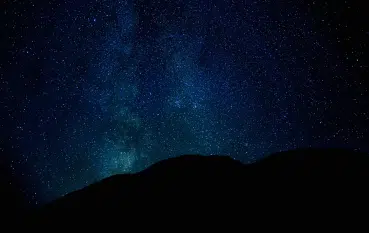
The wind grows stronger and stronger. It rushes through the trees, blowing away the tent I hadn’t secured properly. Then it stops suddenly, abruptly. A few hoots from an owl, and then nothing. On the alert, I strain my ears once more. The sound of silence fills the space. It fills my body just as it fills the entire universe, erasing any sense of separation. Suddenly, the celestial vault appears before my eyes as if by magic —extraordinary, alive, boundless. An endless ballet of points of light with no origin or direction.
How much time passed before dawn broke, and the rain began to fall on me? I have no idea. I just know that I didn’t sleep a wink all night, absorbed by the beauty of the spectacle that unfolded before me.
With my backpack on my back, soaked by the rain but my heart still stirred, I make my way back down the path I had climbed the day before. Ahead of me stands the silhouette of a shepherd, motionless. As I pass him, I stop and can’t help but ask: “Did you see the sky last night—the ballet of those extraordinary stars?” “The sky was overcast all night,” he replied with an amused smile, his gaze—as deep as an endless lake—fixed on me.
As I continue on my way, perplexed, a question swirls in my mind: if the sky remained overcast all night, then what was it that I beheld? Could this space—so extraordinarily real, alive, luminous, and boundless—be that of my own mind. The sky of my primordial nature?
The rain stops suddenly, just as it had begun. Surprised, I look up and my gaze falls on the vast, crystal-clear blue sky that is now revealed. In the sound of silence, everything comes to a standstill once more. Then a realization dawns: I’ll have to go back up there, to experience it again and again, until I’m certain.
“In the wisdom that is like the sky
We are primordially pervasive like the sky
This is a reward that is spontaneously realized.”[1]
1] Excerpt from Star Light. From the Tantra on Awareness that Shines like the Sky – Chapter Five:Teaching the Five Wisdoms – Christopher Wilkinson p 154.
More Posts
The Unique Features of the Termas
In The Unique Features of the Termas, Mila Khyentse explores the main specific characteristics of the terma tradition.

Samsara
Damien here defines saṃsāra: due to a lack of proper understanding of reality, this is a state of great agitation that leads nowhere.
The Terma Lineages
In this article "The Terma Lineages", Grégoire invites us to discover the termas, their transmission and those who rediscovered them.