
Maratika

Written By Maréva Bernard
Blog | Culture and tradition
In this article, Mareva tells us about Maratika, a sacred place in Nepal and a major site associated with Padmasambhava and Mandarava.
Series: The Lineage
Maratika
In eastern Nepal there is a cave.
Several caves.
A special place where Padmasambhava attained immortality.
We are several hours’ drive from Kathmandu. Not so long ago, it would have taken days to walk there.
The story goes that Guru Rinpoche and his Indian consort Mandarava went there to develop a profound practice, even before Guru Rinpoche traveled to Tibet in the 8th century.
After three months of practice, the Buddha of Long Life, Amitayus, appeared to them, and the landscape became inseparable from his palace and its surroundings. Then, to remove all obstacles, they performed the practice of a wrathful deity, and all obstructing forces were banished. [1]
This is what gave it its name, Maratika, which in Tibetan means “’chi ba mthar byed” (pronounced “tchiwa tardjé”), or “the place that destroys death”. It is also known as “Haleshi”, a word “to describe the experience of astonishment”.
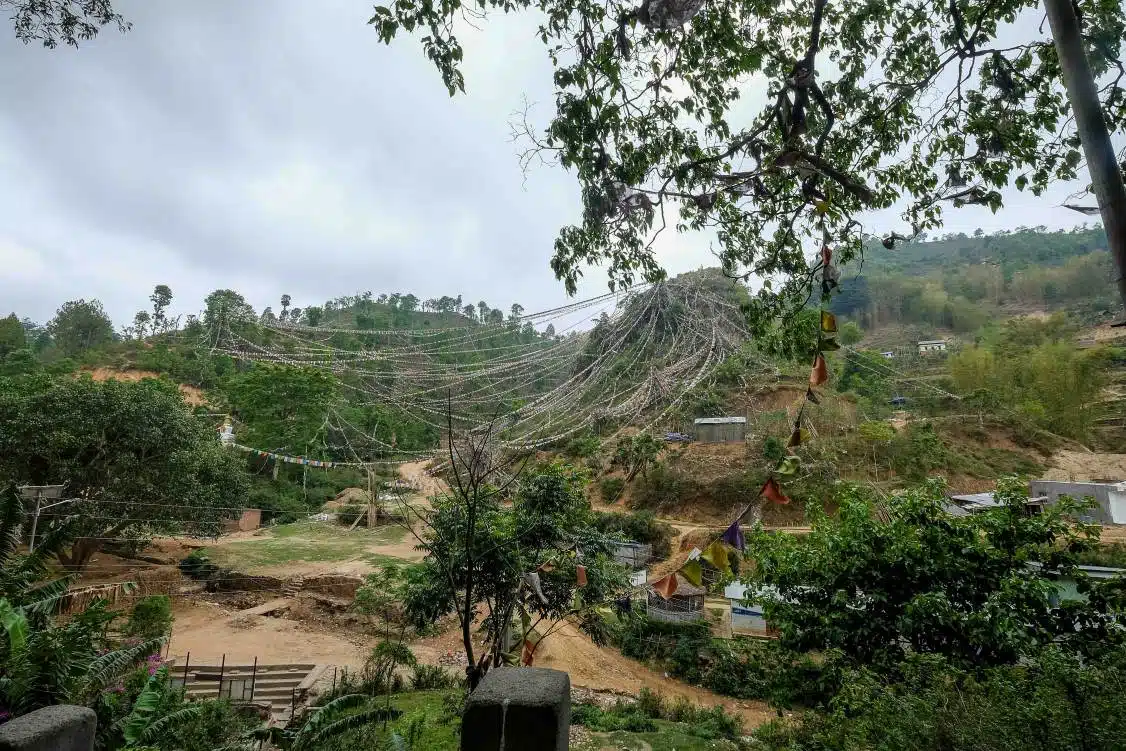
“Today, the town has grown around the caves, but the fervor remains palpable. The power of the place awakens an inner calm undisturbed by crowing roosters and bustling activity.”
Chatral Rinpoche says of the Maratika caves:
“Upon seeing this great place, one cannot help but be astonished.
Just hearing its name will sow the seed of liberation.
Merely bringing it to mind dispels the danger of untimely death.
And by prostrating, circumambulating, and making offerings here,
You will perfect and accumulate an ocean of merit.” [2]
In the main cave, hundreds of bats flit about, like a gathering of dakinis, enlightened female beings who protect the Dharma and the teachings. Sacred objects and depictions of deities have spontaneously appeared on its walls, without human intervention. A vase of long life stands out against a rock, an object of blessing in long-life practices; victory banners are depicted on another section, a universal symbol for Buddhists of the victory of enlightenment over ignorance; a hole in the rock is said to purify the veils and obscurations of this existence…
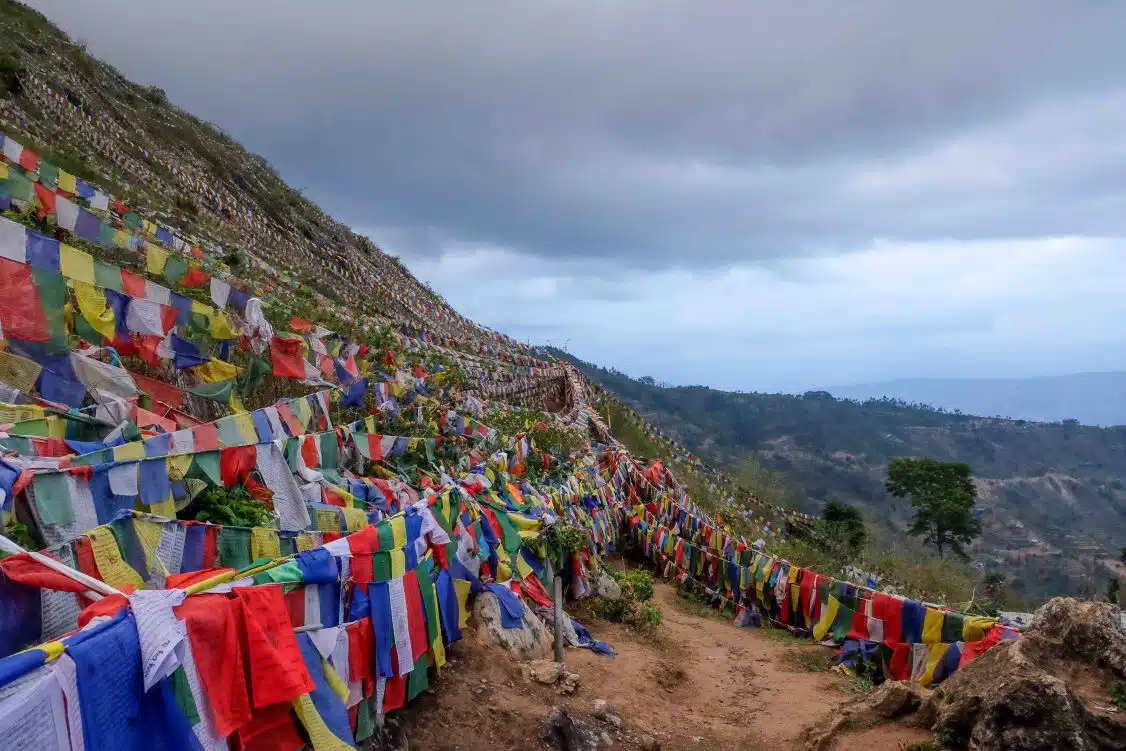
A path winds around the central mountain. The surroundings are lush. The sacred landscape is dotted with other caves, such as the cave of Manjushri, the cave of the Garuda, the cave of the Nagas…
Many great masters have come here to practice, particularly long-life practices, and have highlighted Maratika’s exceptional qualities. Dilgo Khyentse even said that it is one of the six most sacred Buddhist sites in the world, alongside Bodhgaya in India, the Five-Peaked Mountain of Manjushri and the Potala Mountain in China. Trulshik Rinpoche wrote that all 24 sacred sites (places of pilgrimage in the tantras) are contained within these caves.
Today, the town has grown around the caves, but the fervor remains palpable. The power of the place awakens an inner calm undisturbed by crowing roosters and bustling activity.
The butter lamps are burning.
Mantras are being chanted.
Children play.
The imprint of Guru Rinpoche and Mandarava’s profound practice still fills the place. Their presence is palpable.
As Lama Zopa Rinpoche wrote, “In the Maratika Cave, where Guru Rinpoche attained immortality, all your prayers can be answered.”
We can go there on pilgrimage, connect with it, or simply remember its existence, as a living testimony to an authentic tradition.
[1] The lives and liberation of princess Mandarava, Wisdom publication BACK
[2] Melodious Tambura of Delight, Chatral Rinpoché BACK
Sources
https://fpmt.org/in-depth-stories/maratika-story/
https://maratikamonastery.org/history/introduction-and-historical-background/
https://www.lotsawahouse.org/tibetan-masters/chatral-rinpoche/melodious-tambura-of-delight
More Posts
The Story of the First Masters: Jnanasutra
The saga of the early masters of Dzogchen continues with Jñanasutra, who devoted his 500th and final life as a scholar to the practice of the Great Perfection and the attainment of the body of light.

Work as a Basis for Practice
In “Work as a Basis for Practice”, Mila Khyentse talks about working and practicing Dzogchen at the same time in the same place.
Manifestation
In this article, Paul defines manifestation as the play of emptiness of the All-Excellent free from partial grasping.