
On The Mountain Trails

Written By Maréva Bernard
Dzogchen practice | The Dzogchen Journey
Maréva explores the perspectives of the hiker and the shepherd whose experiences oscillate between exertion and contemplation.
Series: Summer in the Mountains
On The Mountain Trails
There are a thousand and one ways to walk a path.
While we sometimes feel we must make great efforts, we project an idealized vision of an effortless path, the way a hiker sometimes fantasizes about the life of a shepherd. Yet, from hiker to shepherd, the separation between these two worlds is only superficial.
Let’s look at them early in the morning.
The hiker — equipped with his pack, his telescoping poles, and his water bladder — has studied his route. He’ll cover 18 kilometers and 1,025 meters of elevation gain today, aiming for the Col du Loup, for a beautiful view of the valley. A scree field awaits him at kilometer 12, but he has the right boots for it and he’s trained. He parks at the trailhead with all his gear.
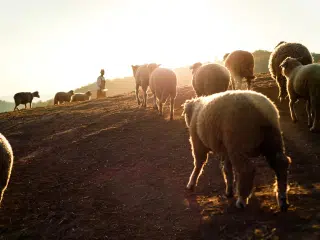
At the same moment, the shepherd has just finished his coffee on the camp stove, facing the sunrise. He’s used to sleeping here, yet he marvels at the ever-changing sky every day. Today, he’s packing up his gear — a small backpack for his two-month journey — because he’s moving to a new pasture. His flock is scattered, but his dogs are watching, and the wind brushes his face.
“Their days are made of effort and contemplation, in turns, and it’s in that back-and-forth that their path unfolds.”
At this early hour, the hiker’s mental load and the shepherd’s appreciation of the present moment seem fairly obvious. But this is only temporary. As the day goes on, other stories begin to unfold.
At kilometer 14, the hiker hears a green woodpecker. He recognizes the sound of its beak against the wood and quickly spots its shimmering plumage. From the woodpecker, his gaze drifts up to the pattern of the bark, and he becomes aware of the scent of the pines, noticing the shades of green. He takes a deep breath and starts walking again, feeling a little lighter. At the Col du Loup, it’s the sky that catches him — streaks of cloud striping the sky, ridgelines outlined in the distance. It had been a long time since he’d enjoyed such a vast view.
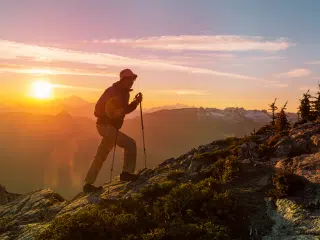
In an instant, all of the hiker’s effort and all his preparation dissolve into the beating of his heart after the climb, into the sounds of the valley, into the scent of flowers in the air. He sits down on a bench, takes out his water bottle, and forgets to check his vitals on his smartwatch.
Meanwhile, the shepherd’s day has also gotten off to a busy start. He ran into a woodcutter who told him about wolf attacks, which worry him. He’s waiting for a strong enough 4G signal to see if there have been any sightings reported in his area. His mind is already anticipating the risk, the distance still to cover, the possible change of route to plan for next year. The magic of the shifting sky has been clouded over by his worries.
As he walks toward the next meadow, he mentally assesses the quality of the grass. Without looking at the distant peaks, he calculates whether he can let his ewes graze there long enough. Successive droughts caused by the warming climate have made his task harder. For a moment, he feels weary. Then a few birds of prey pass overhead, and his weariness lifts for an instant, carried off in the sweep of their outstretched wings, borne by the wind.
Then the encounter happens.
Just past the scree field, where the GR trail and the drover’s path converge, the hiker and the shepherd cross paths. The first pulls out an energy bar to quickly regain his strength for the final kilometers, while the second grabs a blade of grass to chew on, because the taste of the mountain has the same effect on him as a sunrise.
They aren’t so different. Their days are made of effort and contemplation, in turns, and it’s in that back-and-forth that their path unfolds.
The Dzogchen practitioner alternates, too. He plans, prepares, works hard, and sometimes breathes in and out and embraces the vastness.
The hiker has his kilometers to cover, the shepherd his flock to move to a new pasture, and the Dzogchen practitioner his retreat to organize.
His schedule is meticulously planned out. The shopping is done, and the first-aid kit has been checked three times. He inventories his practice materials, makes sure he has enough cushions to support his seat, and sets his alarm for 5 a.m. with a slight grimace because he’s not a morning person, but trusts the instructions anyway.
By the end of the first week, a rhythm has settled in. The cushion has kept the imprint of the day before. The morning routine has become automatic. The effort of visualization in practice gradually gives way to a natural unfolding. By the end of his retreat, as he boards the train home, he senses that what he found there is still with him. Contemplation doesn’t depend on the cabin where he practiced; it depends on his mind.
Then 350 unread emails knock him offline again, and that evening, back home, he sets up his cushion and sits down hoping it will relax him — then remembers that isn’t the point. He recalls what he found on retreat, connects to the lineage, and makes aspirations for the awakening of all beings.
The practitioner oscillates between effort and contemplation, and this oscillation is part of his path — until the moment the two merge into a single flavor.
Like the hiker and the shepherd walking on the mountain, caught by the beauty of the world when the view opens up.
More Posts

Manifestation
In this article, Paul defines manifestation as the play of emptiness of the All-Excellent free from partial grasping.

Crossing the Pass
In “Crossing the Pass”, Maréva explores the symbolism of crossing mountain passes in the Himalayas and in the West, and its connection to the practitioner’s path.
Is the Marmot a Yogi?
In “Is the Marmot a Yogi?”, Damien outlines a definition of what a yogī might be according to the Dzogchen tradition. Series: Summer in the...