

The Peacock feathers radiant display
Directly looking at the dynamics of emotions in the Dzogchen tradition
Last night, I had a dream… I dreamed that I was evolving in a world where emotions emerged like colors that were tinting the whole environment. Blue for anger, red for desire, green for jealousy, yellow for pride… The colors mixed with each other in as many shades as subtleties. In this infinite palette of possibilities, the mind, like a painter, drew its own reality. And in this painting of trees with turquoise foliage, ruby colored sky, emerald green birds and canary yellow clouds, I was witnessing an extraordinary and moving display… Everyday, if we had the possibility to see the environment tinted according to our emotions, we would be really surprised to perceive how much they impregnate the reality to make it what we believe to be our reality.

Written By Johanne Bernard
Blog | General Introduction to Dzogchen | The Dzogchen basics | The Dzogchen Journey
In the Peacock feathers radiant display, Johanne draws a beautiful parallel between our emotions and the radiant display of a peacock’s feathers. A must read!

“
Finally, when we learn to observe directly, the emotions allow us to perceive the extraordinary nature of our mind. It is because we have a body, thoughts, sensations, perceptions, and emotions that we have the possibility to access and recognize this nature…
We think we know emotions well: we have lived with them since we were young. They are like partners who accompany us throughout our lives. Some are our friends. We cherish them, and try to stay with them as much as possible because they are comfortable. Others are our enemies, and we avoid them at all costs, because they scare us or disturb us. Emotions are part of us. We have the impression that they constitute our identity: “This person is of a ‘jealous’ nature”, “such other one, since baby, was ‘angry'”… We attribute to them at the same time an external origin: this neighbor systematically makes us angry, this situation makes us afraid… A memory, sometimes, is enough to trigger them. And this endless ballet often exhausts us. How good it would be not to feel emotions sometimes!…
But, let’s come back to the dream of the beginning, what would become the extraordinary moving display that our mind offers, if the emotions were to disappear?
Dzogchen does not tell us to stop these emotions, it is impossible! Emotions are the expression of the dynamics of the mind. Like a peacock unfurling its feathers, the emotions are constantly flowing, revealing through the iridescence of their multitude of eyes, the incredibly agile quality of our own mind… If we feel affected by this deployment, it is because we are focusing our attention on the emotion itself, rather than on its dynamics. The Dzogchen tradition suggests that we let go of the concept of “emotion” and just watch its appearance, like a peacock watching the unfolding of its own feathers in a mirror. By remaining an observer of the incessant movement of our mind -unfolding, disappearing, unfolding- we gradually become accustomed to focusing our attention directly on the dynamic process of manifestation, rather than on its outcome.
By training ourselves in this way, we no longer recognize emotion as having an existence of its own, but as a dynamic. Recognized as an expression, a movement, the emotions spring up and disappear in an incessant but now natural game. Like bubbles on the surface of the water, they emerge and then return to their essence, which is the primordial basis of the mind, for the Dzogchen tradition. Anger, desire, pride, jealousy continue to emerge but, ungrasped, spontaneously free themselves and naturally return to their essence. Nothing needs to be removed or added. Nothing is to be done! The mind awakens to its own nature.
In the Dzogchen tradition, we speak of the ‘five basic passions‘ (desire-attachment, anger-aversion, confusion, pride, and jealousy) as the manifold expression of the nature of the mind. The peacock feathers symbolize the direct vision of these five passions as the five wisdoms, the manifestation of the luminosity of Rigpa.
Finally, when we learn to observe directly, the emotions allow us to perceive the extraordinary nature of our mind. It is because we have a body, thoughts, sensations, perceptions, and emotions that we have the possibility to access and recognize this nature… And this is also what “precious human existence “ means in Dzogchen!
So let’s rejoice, Emaho!!! as it is said in the tradition.
You can also listen the podcast on the emotions HERE.
More Posts

The Great Perfection at Work?
In this article, Vincent explores the role of spiritual practice in the workplace and the question of whether the two are compatible.

Personal Branding: The Self in the Image
In this article, Grégoire explores whether we are our image and to what extent we can play with it to liberate ourselves.
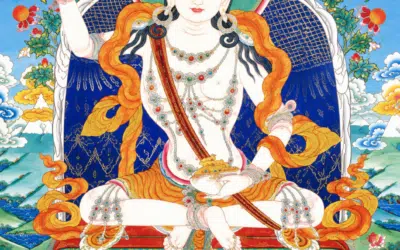
The Story of the First Masters: Jnanasutra
The saga of the early masters of Dzogchen continues with Jñanasutra, who devoted his 500th and final life as a scholar to the practice of the Great Perfection and the attainment of the body of light.

Work as a Basis for Practice
In “Work as a Basis for Practice”, Mila Khyentse talks about working and practicing Dzogchen at the same time in the same place.

Manifestation
In this article, Paul defines manifestation as the play of emptiness of the All-Excellent free from partial grasping.

Crossing the Pass
In “Crossing the Pass”, Maréva explores the symbolism of crossing mountain passes in the Himalayas and in the West, and its connection to the practitioner’s path.