
Using geomancy to choose your vacation destination

Written By Paul Baffier
Reflections on life
Paul explores how Tibetan geomancy can help us choose a vacation destination that soothes the mind and supports our spiritual journey.
Series: Summer in the Mountains
Using geomancy to choose your vacation destination
It’s time to head out for summer vacation! Generally speaking, we choose our destination based on the season and our preferences: mountains or the sea, coconut palms or snow, cultural outings or trendy nightclubs, a royal suite with a view or a secluded cabin, exotic cocktails or fine aged wines…
But what if we chose our destination differently, focusing on its intrinsic qualities to promote peace of mind and support concentration?
So let’s assume we go on vacation, not to escape our dull or toxic daily lives, but to help us rediscover something within ourselves that is deeper and nobler than anything we think we must experience in an ordinary way.
Let’s assume we’re leaving, not to “take a break”—an artificial respite that will vanish in an instant as soon as we return home—but to rediscover something that has never left us, and therefore can never leave us: our own capacity for mindfulness, our own potential for kindness, directed toward ourselves as well as toward others.
“Let us therefore keep our eyes on these places that we must nurture and preserve, as they offer us the opportunity to rediscover our natural great vacation.”
This would lead to a completely different choice of vacation destination. A vacation from ourselves that would open up our own space to a more essential naturalness and authenticity. This would therefore require a different kind of knowledge about the places we visit and where we live.
This complex and subtle knowledge exists and has endured in many traditional cultures. It is called geomancy. In Tibet as well, geomancy (Tib. sa dpyad, pronounced “satchè”), connected with astrological knowledge, was used to identify and construct sites for spiritual practice where one could rediscover the essence of being, places for the protection of knowledge, and wholesome sites enabling self-transformation and an introduction to the nature of the mind—the pristine (Tib. dri med, pronounced “drimé”) primordial evidence (Tib. rig pa) of the ultimate aspect of our reality (Tib. don dam, pronounced “döndam”).
For example, it is said to be auspicious for a new temple to be situated in front of a mountain, on a central elevation with rocks and fields, facing lower mountains; two rivers, flowing from the right and left, converging in front of it. A road leading eastward is favorable, as is a river flowing southward; a large rock to the north is auspicious, as is a large tree situated below the temple. Various other signs can qualify, counteract, or negate these qualities: for example, a spring located below or behind a temple is not favorable, unless it is situated to the right of the “temple”… our vacation spot.
Other elemental aspects of a place’s configuration support the health and longevity of the practitioners who reside there, or enhance the intensity of the practices performed there, etc. After all, let us not forget that mountains are alive… . The subtle elements that make up the practitioner’s reality are immersed within the subtle elements that animate the environment of the place. Therefore, if our environment consists of mining, air pollution, cut-down trees, animal suffering, and meaningless jobs, we shouldn’t be surprised to find ourselves exhausted, depressed, and burned out.
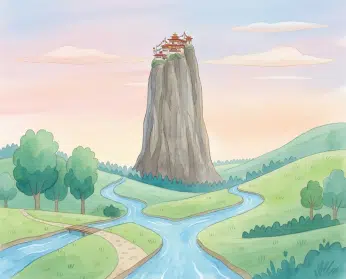
On the other hand, if we nurture the life force of the places where we live, and if we respect the beings and plants that dwell there or settle there, then the entire physical environment becomes a vessel for the breath of life and fosters inner growth. In Compassionate Action, Chatral Rinpoche wrote that waterfalls inspire reflection on impermanence, while dark, steep cliffs with jagged profiles evoke the wrathful aspects of the mind and encourage meditation on them, whereas gentle hills with flower-filled fields provide a natural setting for practices of pacification.
Chatral Rinpoche wrote:
All around and in every place, fragrances fill the air,
Plantains and other edible plants
Bloom in abundance without being sown,
Amiable birds, waterfowl, and wood pigeons
Empty the mind of its weariness.
Inner understanding and virtues naturally increase,
Benefiting the activity of path, view, and meditation.
Geomantic knowledge is thus yet another invitation to refine our perspective on the places we frequent, for the study of their external layout will reveal the kind of internal influence they have on our mood, our concentration, and ultimately on our spiritual path.
It is through this subtle, long-term vision of places that enlightened beings such as Emperor Songtsen Gampo made Tibet a field of spiritual activity and compassion, which still radiates their benevolent intention. Pawo Tsuklak recorded the emperor’s delighted poem:
Nearby meadows, distant meadows : the virtue of grass.
Land for building, land for planting: the virtue of earth.
Water for drinking, water for irrigation: the virtue of water.
Stone for building, stone for grinding: the virtue of stone.
Wood for building, wood for heating: the virtue of wood.
Let us therefore keep our eyes on these places that we must nurture and preserve, as they offer us the opportunity to rediscover our natural great vacation.
Bibliography:
Konchog Lhadrepa & Charlotte Davis, The Art of Awakening: A User’s Guide to Tibetan Buddhist Art and Practice, Shechen Publications, New Delhi, 2017.
Chatral Rinpoche, Compassionate Action, Snow Lion, New York, 2007.
More Posts
Termas in the World Today
In “Termas in the World Today”, Mila Khyentse talks briefly about the Terma tradition and practice today and in the near future.
Maratika
In this article, Mareva tells us about Maratika, a sacred place in Nepal and a major site associated with Padmasambhava and Mandarava.
The termas conditions
Johanne talks about the convergence of all the necessary conditions for the termas discovery, application, and transmission.