
The Unique Features of the Termas
Written By Mila Khyentse
Blog | Culture and tradition | The Dzogchen Journey
In “The Unique Features of the Termas”, Mila Khyentse explores the main specific characteristics of the terma’s lineage traditions.
Series: Highlighting the Terma Lineages
The Unique Features of the Termas
For those with a close or distant interest in Tibetan Buddhist or Dzogchen tradition, one term often remains mysterious: terma (Tib. gter ma). Previous articles, such as “A Living Tradition: The Kama and Terma Lineages” and “The Terma Lineages,” have covered the basics of termas. Here, we will explore their specific characteristics.
“(…) termas are renowned for providing a direct path, a “shortcut,” to the realization of the primordial nature of our mind, for, it is said, the “warm breath” of blessing is still fully present.”
The first distinctive feature is that these special teachings are defined by conditions—often complex ones—that determine their emergence, unfolding, “effectiveness”, and longevity. Due to the complexity of these conditions, we can never be certain whether a terma will manifest or not. The failure rate in the terma tradition is quite high! Johanne talks about the conditions of termas in her post.
The second distinctive feature is that these teachings are not innovations, since they were first transmitted in the 8th century and have been “preserved” in the mind of the Tertön (Tib. gter ston) ever since, until the time of their rediscovery. However, the “innovations” of each terma cycle depend on the evolution of the mental conditions of the beings who will receive it. Thus, the tradition speaks of the increasing complexity of the teaching cycles and their associated practices, as the mental pathways of beings become more complex from one period to the next.
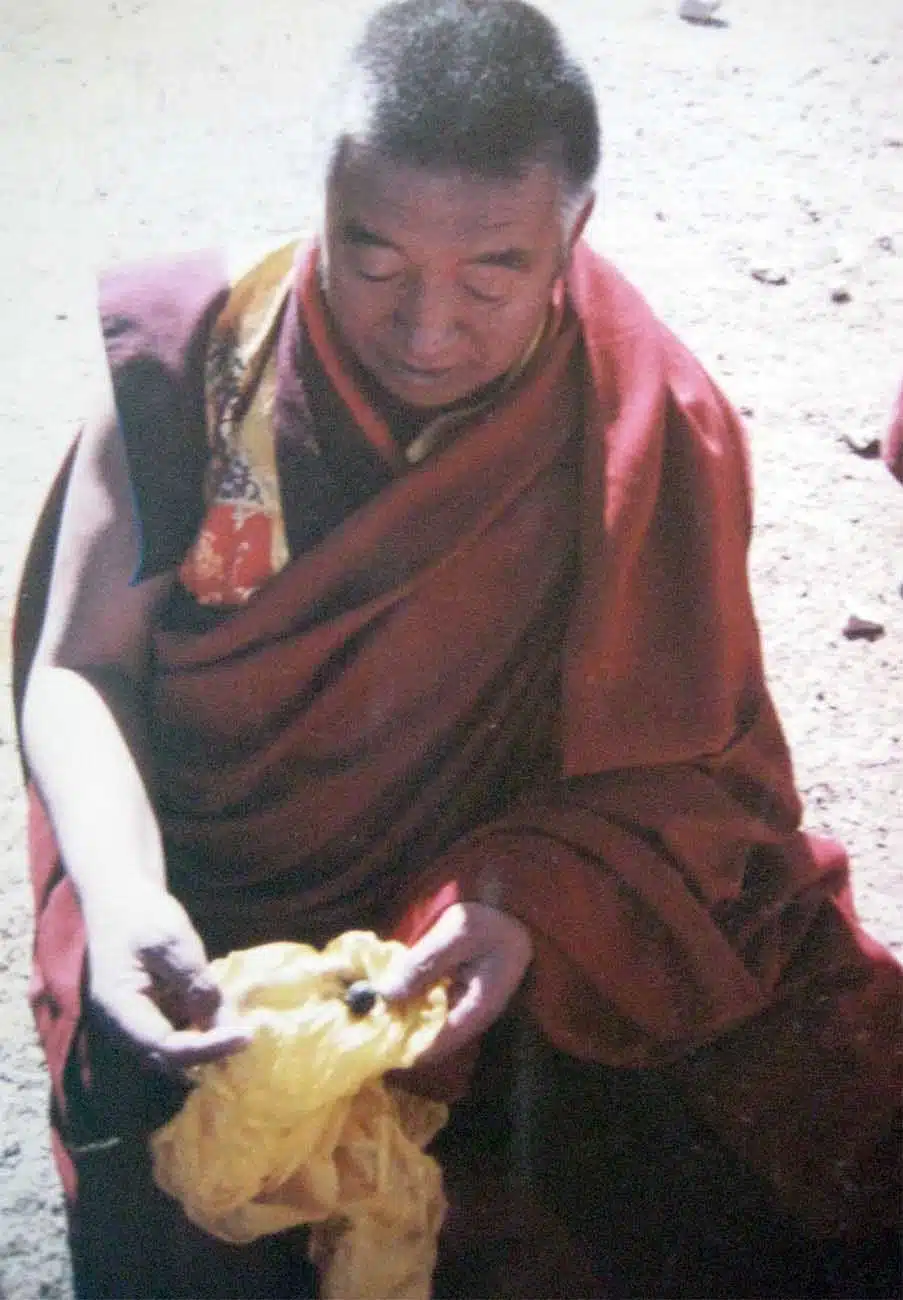
Alags Chorten showing a terma-healing pill. Amdo, Eastern Tibet. ca 1980.
Title slide: Alags Chorten digging up a terma from the ground. Amdo, Eastern Tibet. ca 1975.
The third distinctive feature is that termas are renowned for providing a direct path, a “shortcut,” to the realization of the primordial nature of our mind, for, it is said, the “warm breath” of blessing is still fully present. This blessing is present because the tertön who rediscovered the terma teaching is the link that connects us directly to the wisdom mind of Padmasambhava (we also sometimes speak of the terma cycles of Vimalamitra and Vairocana). Thus, it is an unbroken lineage, as if we were receiving the teachings directly from one of Guru Rinpoche’s twenty-five principal disciples, or even from Guru Rinpoche himself. The closer in time the teaching is, the greater the power of the blessing. This is why the most recent major terma teachings, such as those of the Longchen Nyingthig (Tib. klong chen snying thig) or the Dudjom Tersar (Tib. bdud ‘joms gter gsar), are the most widely practiced in the world today.
The fourth distinctive feature is that the teachings—the treasure texts themselves—are often accompanied by “support objects” that serve as “enlightenment treasures through the five senses.” My master, Alags Chorten (Tib. a lags mchod rten), recovered many of these support objects, primarily healing pills. Most of the time, he would dream about them the night before their rediscovery, including the people for whom they were intended, the location where they would be found, what offerings needed to be made in exchange so that the site would retain its power, and so on. The people who received the pills or other objects, generally suffered from an incurable illness, from which they were cured after ingesting the enlightenment treasures. They would then invariably turn their minds toward the teachings of the termas and toward Padmasambhava.
The fifth distinctive feature is that these rediscovered teachings are time-bound, as they pertain to a specific period and specific needs. They are therefore destined to disappear, a fact that is generally stated within the teachings themselves. Indeed, it is said that the blessing that sustains the termas diminishes over time, causing them to eventually disappear. Although it is also said that other termas will reappear in other places—not necessarily on this earth—and in other eras. The sixth and final distinctive feature we will discuss here is that the terma cycles, the objects, and the treasure discoverers are all known through the lists given by Padmasambhava to Yeshe Tsogyal, one of his mystical companions, to whom he entrusted the task of hiding a large part of his treasures for future generations.
These characteristics make the termas unique teachings of the Himalayan world, of which we are the fortunate beneficiaries today. Good karma!
More Posts
The Three Ways to Rejoice your Masters
In “The Three Ways to Rejoice your Masters”, Paul offers us a useful traditional reading grid to structure our thinking and action.
Indiana Jones and the Invisible Path
In « Indiana Jones and the invisible path » Paul offers us an article in which we learn that Dzogchen can be seen in a popular film.

Simply with confidence
How can we walk the path of Great Perfection? Grégoire proposes to do so, beyond doubts and questions, “Simply with confidence”.