
The Terma Lineages
Written By Grégoire Langouet
Culture and tradition | General Introduction to Dzogchen
In this article “The Terma Lineages”, Grégoire invites us to discover the termas, their transmission and those who rediscovered them.
Series: Highlighting the Terma Lineages
The Terma Lineages
The termas are the “treasure” teachings primarily entrusted by Padmasambhava and Yeshe Tsogyal to their disciples and future heirs, the tertöns (Tib. gter ston), or “treasure discoverers.” These termas have been revealed over the centuries up to the present day, beginning in the 11th century. They often seem like a strange phenomenon to us, and it can be difficult to understand how they work. To understand them, one would have to ask the “treasure discoverers” themselves, or at least a fully realized master… Tulku Thondup Rinpoche brilliantly accomplished this in his work, the “Hidden Treasures of Tibet,” which was influenced by The Ocean of Wonders (Mtshar rgya mtsho) by the Third Dodrupchen Rinpoche, Jigmé Tenpé Nyima (1865–1926), and with the oral guidance from other eminent masters such as Dudjom Rinpoche, Dilgo Khyentse Rinpoche, and the 4th Dodrupchen Rinpoche (1927–2022).
Regarding termas, the essentials have already been outlined in a previous article, which is well worth consulting. Here, we will only clarify a few points. You, the readers, will have to discover the rest.
Alongside the oral lineage (kama) (bka’ ma), the terma lineage is found primarily in the Old School (rnying ma pa) but is also present in the New Schools (gsar ma pa)—as seen, for example, with certain Dalai Lamas; one thinks, for example, of the great Fifth Dalai Lama, Ngawang Lobsang Gyatso (1617–1682)—and also among the Bönpos—with some tertöns even belonging to both traditions. Furthermore, this is not a phenomenon specific to Vajrayāna Buddhism and Dzogchen, since it is, in a certain sense, already present in Mahāyāna. The best-known example is certainly that of the Prajñāpāramitā in One Hundred Thousand Verses, hidden in the world of the Nāgas [1], and rediscovered by the king of the Nāgas, Nāgārjuna. Many major tantras—the primary texts supporting Vajrayāna practices—have also been revealed as termas. Most pertain to inner tantras and Dzogchen.
“Ultimately, reality itself is the teaching, for those who have the capacity to perceive it. It is within this framework that termas arise for the benefit and according to the needs of the disciples, to keep the continuity of the transmission alive.”
There are two types of termas: earth termas (sa gter) and mind termas (dgongs gter). Earth termas rely on a material medium, often a yellow parchment scroll (shog ser), to awaken or reactivate the teachings transmitted to the wisdom mind (dgongs) of the future tertön. Mind termas do not require such a physical medium, though favorable external circumstances, such as a suitable place or a gathering of specific people, facilitate rediscovery. These yellow scrolls can be found in rocks, lakes, or sacred places, and sometimes take forms other than scrolls. Finally, there are types of pure visions (dag snang), whether experienced while awake or asleep, in dreams, which can be termas. Multiple combinations are possible. The circumstances of their appearance are always unique. Each discovery seems to be one of a kind.
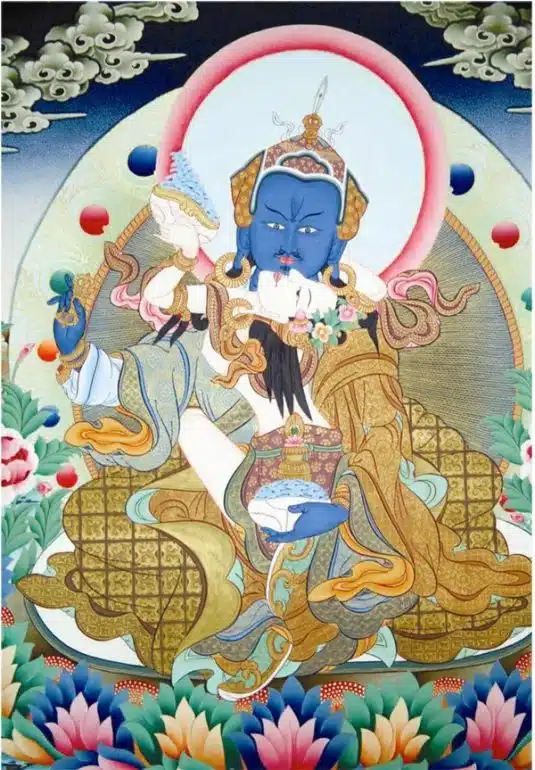
An important aspect of how termas work is connected to the idea that the Buddha Śākyamuni himself never taught based on his own personal intentions. Rather, his “teachings” manifested spontaneously, in response to the specific needs of his disciples—he “being” and abiding in the ultime aspect of reality (chos nyid). Thus, teachings that appear as spoken words from a human being or in the form of texts are not inherently different from termas. They appear according to the perception of reality by sentient beings who aspire to discover Reality itself through these teachings, whether they be texts, words, trees, the sky, a ray of light—or any other form whatsoever. Ultimately, reality itself is the teaching, for those who can perceive it. It is within this framework that termas arise for the benefit of the disciples and according to their needs, to maintain the continuity of the transmission.
Among these terma discoverers, there are five “great” tertöns, as well as hundreds of other major and minor tertöns, including some today. The five great tertöns are, in chronological order and according to most lists, Nyangrel Nyima Özer (1124–1192)—discoverer of the Copper-Colored Mountain (Bka’ thang zangs gling ma), the first complete hagiography of Padmasambhava—Guru Chöwang (1212–1270), Dorje Lingpa (1346–1405), Pema Lingpa (1450–1521), and finally Jamyang Khyentés Wangpo (1820–1892). The characteristic often cited to distinguish a major tertön from a minor one is either the discovery of a complete cycle of teaching, or the presence, among his discoveries, of three categories of termas: some related to Padmasambhava himself, others to Avalokiteśvara, and finally the teachings of Dzogchen, the Great Perfection.
Throughout the history of Buddhism and Dzogchen in Tibet, tertöns have succeeded beginning with Sangye Lama (1000–1080) and Drapa Ngönshé (1012–1090)—who is credited with discovering the Four Tantras, the foundational texts of the Tibetan medical tradition. In addition to the five major tertöns, we should also mention, among many other, Zhangton Tashi Dorje (12th century), discoverer of the Bima Nyingthig, Jomo Menmo (1248–1283), the spiritual companion of Guru Chöwang, Rigdzin Gödem (1337–1403), discoverer of the Northern Treasures, and Karma Lingpa (14th century), discoverer of the Shitro Gongpa Rangdrol cycle, from which the Bardo Thödol Chenmo teachings, also known as the “Tibetan Book of the Dead,” originated.

To clarify a bit how the revelation of these “treasure” teachings work, in addition to the three “ordinary” types of transmission—mind-to-mind, symbolic, and oral—there are three extra-ordinary types of terma transmission: 1. through prophetic authorization (bka’ babs lung bstan); 2. through “mind mandate” (gtad rgya) or the force of aspiration, and 3. via the ḍākinī and the protectors. In the first case, Padmasambhava “predicted” to his disciples that tertöns would “return” at a certain time and that the transmitted teachings would be rediscovered. In the primary case of the mind mandate, the teachings are “secured” within the disciple’s mind-nature (sems nyid). Finally, other teachings were entrusted to the ḍākinī and various protectors in order to preserve them until their rediscovery under very specific circumstances.
The rediscovery of termas therefore depends on how the teachings were transmitted. The element that serves as a trigger to reactivate the memory of the teaching is therefore often, as we indicated, a yellow parchment scroll that may contain three types of signs: either in ḍākinī script or in Tibetan script—until termas in other languages are perhaps revealed one day? Thus, one finds either simple signs, a few letters or syllables that are not even words (which are “merely visible”: snang tsam); or more substantial elements, such as a title, a summary, etc. (which are “merely an indication”: rten tsam); or finally, complete texts (mthar chags), which in this case do not need to be “deciphered” or decoded, unlike in the first two cases. For the discovery does not always provide direct access to comprehensible instructions in the form of a readable text. Many other conditions will still be necessary for the teaching to be properly received, put into practice, and realized before being passed on in turn…
Sometimes, in a more or less extraordinary manner, a tertön receives a “prophetic guide” (kha sbyang) who indicates the termas to be rediscovered, their location, the appropriate time, the necessary spiritual partner and disciples, etc. Moreover, discoveries of these treasure teachings can take place privately, with only the tertön present, or with a few disciples, or even publicly, as Mila Khyentse Rinpoche’s own master, Lobsang Dargye Gyamtso Rinpoche, also known as Alags Chörten, did on several occasions.
Whether in the midst of lakes or in nearly impenetrable rocks, treasures are still being discovered, in ways that are more or less fabulous… But the fascinating stories of some of these discoveries, such as the famous one of the Longchen Nyingthig by Jigme Lingpa or more recent ones from Namkhai Norbu Rinpoche—including those from dreams—and the contemporary ones from Adzom Chotrul Paylo Rinpoche, in addition to those from Alags Chörten, will be covered in future episodes…
[1] Serpent spirits classified among the eight categories of gods and demons, or sometimes considered animals or demigods. They live beneath the earth’s surface or in water, as well as in trees or rocks, and are attributed with magical powers (www.rigpawiki.org). BACK
More Posts

A Garland of Light
In “A Garland of Light”, Johanne talks about the way the lineage of the Great Perfection is passed on, since its beginning.
Stories When the Light Fades
In “Stories When the Light Fades”, Mila Khyentse recalls some of his Master’s Jack-o’-lantern stories told at night.

The ground (gzhi)
This article is the first in a new category designed to provide a better understanding of the essential words and concepts of Dzogchen.