
The Story of the First Masters: Sri Simha

Written By Nils Derboule
Blog | History of Dzogchen
We continue the life stories of the first Dzogchen masters with Śrī Siṃha, who structured the four Dzogchen series into four cycles.
Series: The Lineage
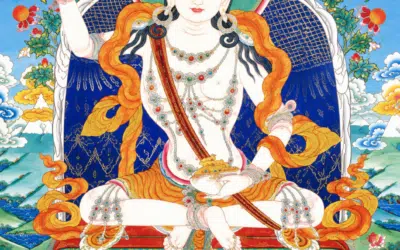
Sri Simha
Sri Simha (Skt: Śrī Siṃha,Tib: Pèlgyi Senggé, Dpal gyi seng ge) was born in the city of Shokyam, in China. His father, a “householder,” was named the “Virtuous”, and his mother the “Wise and Clear”. Drawn to knowledge from an early age, he left his family home at age 15 to study under Haribhala, at the foot of the Chinese Bodhi tree. He studied the five sciences [1] for three years until he had mastered them.
One morning, as he was riding a camel to the city of Suvarnadvipa, taking advantage of the brightness of a clear day to run errands for his master and perhaps teach the child of a nobleman, the lord of great compassion, the enlightened being Avalokiteshvara, appeared to him in a vision in the sky and said:
“O fortunate son of good family [2], if you truly wish to attain Enlightenment, there is a city in India called Sosadvipa: go there!”
Though gladdened by this prophetic utterance, Sri Simha hesitated. After deep reflection, he came to the conclusion that in order to receive and benefit from the extraordinary teachings he would find in India, he must first study the outer and inner Buddhist tantras thoroughly.
After informing his master of his intention, he set out for the famous Five-Peaked Mountain (Wutaishan), the abode of the great enlightened being Manjushri, without further delay. There he studied the tantras for seven years under the master Bhelakirti, took the vows of a bhikshu (Buddhist monk), and continued his study and practice for thirty more years, maintaining the discipline of his vows with a rare rigor… very nearly forgetting Avalokiteshvara’s prophecy.
The nature of mind, however, does not forget: the lord of great compassion manifested to him once again in a vision and repeated the very same words:
“O fortunate son of good family, if you truly wish to attain Enlightenment, there is a city in India called Sosadvipa: go there!”
But Sri Simha dithered yet again.
He told himself: “Should I go to India today? It’s far too dangerous, I’ll never manage it. Unless I develop the power of swift walking.” So for three years he visualized and recited a mantra in order to attain this accomplishment.
He then set out, moving fifty centimeters above the ground. It wasn’t quite as fast as taking an airplane, but nine days and nine nights later (instead of several months), he arrived in one piece at Sosadvipa, where he met Manjushrimitra and begged him to accept him as a disciple.
Twenty-five years of transmission and practice followed, punctuated by a stay at Shitavana during which he received the ultra-secret teachings directly from Prahevajra, which he would later transmit to Padmasambhava and Vairocana. [3]
Sri Simha remained in this way with his Dzogchen master until the vidyadhara’s body dissolved into a great mass of light. Music and shimmering lights filled the atmosphere, and Sri Simha lamented seeing his master pass into nirvana.
Suddenly, Manjushrimitra reappeared in the sky and placed a tiny casket in the hollow of his hand. Inside, Sri Simha discovered his master’s spiritual testament, The Six Experiences of Meditation. Total confidence in his own realization arose in his mind, and a perfect understanding of all the tantras dawned.
Overjoyed, he traveled to Bodhgaya, where he found the texts hidden by Manjushrimitra. Then, he returned to China and organized the third series of Dzogchen teachings — the series of direct instructions — into four sections: outer, inner, secret and ultra-secret.
He concealed the first three cycles, considered “elaborate,” near the Chinese Bodhi tree. Finally, urged by the Dakinis, he hid the last cycle at Tashi Trigo, the gate of the myriad auspicious omens.
He then continued his practices at Siljin, where Vimalamitra and later Jnanasutra came to request teachings on the Great Perfection from him.
But that is another story…
[1] The five sciences are: the “inner” science (i.e. of the Dharma, of reality), the science of logic and reasoning, the science of language (grammar and literature), the science of medicine, and the science of arts and crafts. BACK
[2] Sri Simha was not from a noble human family, but he belongs to the noble family (or family of goodness) of practitioners of the Buddha’s teachings, namely the bodhisattvas or enlightened beings. BACK
[3] This stay at Shitavana appears only in certain sources drawn from termas, notably the treasure-cycle of the Khandro Nyingthik. BACK
All the other stories:
The Story of the First Masters: Manjushrimitra – Dzogchen Today!
The Story of the First Masters: Garab Dorje – Dzogchen Today!
More Posts

Personal Branding: The Self in the Image
In this article, Grégoire explores whether we are our image and to what extent we can play with it to liberate ourselves.
The Story of the First Masters: Jnanasutra
The saga of the early masters of Dzogchen continues with Jñanasutra, who devoted his 500th and final life as a scholar to the practice of the Great Perfection and the attainment of the body of light.

Work as a Basis for Practice
In “Work as a Basis for Practice”, Mila Khyentse talks about working and practicing Dzogchen at the same time in the same place.