
Losar!

Written By Paul Baffier
General Introduction to Dzogchen | Reflections on life
In “Losar!”, Paul offers us a reflection on repeating cycles and the subtle link between tradition, humanity and the universe.
Series: Happy new year !
Losar!
-“Losar* [1] ! A year already!”
-“…we say to ourselves every year…”
-“And how long have we been saying it?”
-“For years…”
Yes, many, many years that time passes at the pace of the moon [2], following the seven-day week system, corresponding to the seven main planets of the solar system.
We forget, but our time, whether professional or family time, is intimately linked to this movement of the stars, in traditional cultures as well as in modern culture…
We forget it, but our time, whether professional or familial time, is intimately linked to the movement of the stars, in both traditional and modern cultures.
“The powerful gravitational movements of celestial bodies correspond to the recurring tendencies of our emotions, decisions, and life paths… ”
This sense of infinity that overshadows our daily lives, much like the Milky Way dominates our night sky, was established long ago. So long ago… The Mesopotamians were already using the predictive model of a lunisolar calendar as early as the third millennium BCE. In the 13th century, the Mongol conquerors also had a predictive governance system; some 5,000 Nestorian, Arab, and Chinese astrologers practiced divination and calculations according to their respective models in the capital, Khanbalik (Beijing), during the time of Khan Genghis.
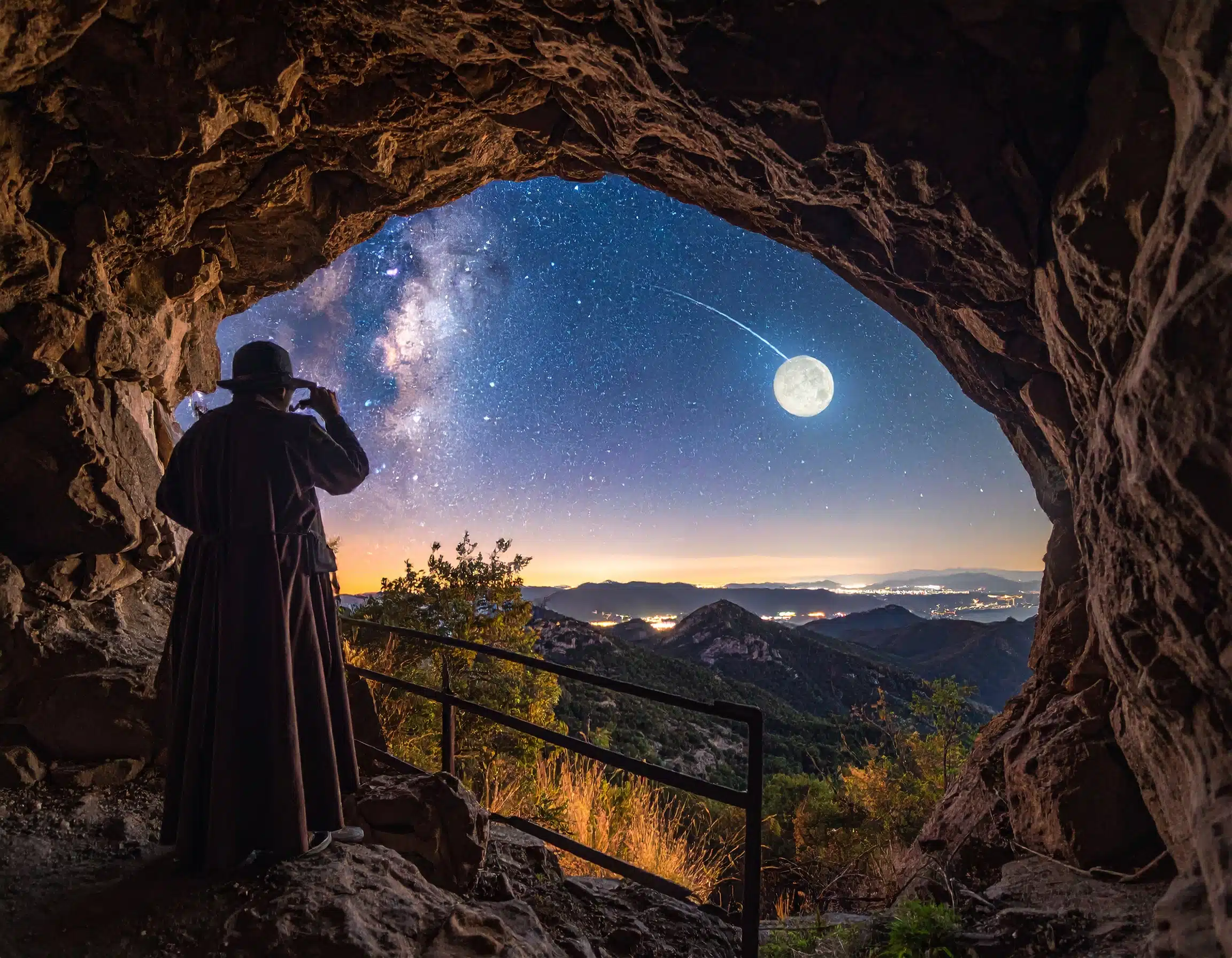
In many traditional cultures, the macrocosm of the vast universe is connected to our own “personal” microcosm. The powerful gravitational movements of celestial bodies correspond to the recurring tendencies of our emotions, decisions, and life paths, whether they involve an individual or an entire people, or are personal, political, military, or spiritual.
In the Tibetan tradition, these endless cycles that repeat themselves over and over again have been calculated according to a sixty-year cycle that repeats itself: the famous hexadecimal cycle (Tib. bcu drug gong ‘gril lugs), in which each year is composed of an element (earth, water, fire, air, wood, metal) and an animal. This year we are in the “Fire Horse”.
“But what does this have to do with the Great Perfection?” we might ask.
Well, some Dzogchen masters were also keen on astrology, because knowing the movement of the planets and their conjunctions helps us to understand the movement of the forces that pass through us. And structuring the chaos of reality by understanding how it works is a way of preserving the common good.
Thus, Rangjung Dorje, the Third Karmapa (1284-1339) -a fellow student of Longchenpa under the tutelage of the great Kumaradza- wrote a treatise on astrology based on the Kalachakra Tantra. He then established a modified astrological tradition, the Tsurphu System (Tib. mtshur lugs), which employed a distinct calculation method. Similarly, Mipham (1846-1912), a learned Dzogchen master and clock inventor, among other things, paid attention to the movement of the stars. Did he not declare in a private interview with Khenpo Ngakchung at Dzogchen Monastery:
“Today, the constellations of Cancer and Jupiter are aligned, and you arrive just as I have finished my philosophical treatise. This is an extremely favorable sign for you.”
Indeed, the entire universe resonates within us, and a whole year has passed.
[1] “Losar” means “New Year” in Tibetan (lo: year; gsar: new). BACK
[2] The Tibetan calendar is based on the lunar cycle. BACK
The quote from Mipham Rinpoche and other information are taken from the following sources:
Khenpo NGAWANG PALZANG, Merveilleuse danse illusoire, Autobiographie de Khenpo Ngawang Palzang, Eusèl Rinchèn Nyingpo Péma Lédrel Tsal, Padmakara, 2021.
Brian BAUMANN, Divine Knowledge : Buddhist Mathematics according to the Anonymous Manual of Mongolian Astrology and Divination, Brill, 2008.
Philippe CORNU, L’astrologie tibétaine, Trédaniel éditeur, 1996.
http://kalacakra.org/calendar/os_tsurphu.htm BACK
More Posts

Being Your Own Master
Relationship with a master requires discernment. “Being your own master” offers insights into understanding devotion and avoiding pitfalls.

Phenomena
"Phenomena" is the second entry in a new category designed to improve understanding of essential Dzogchen words and concepts.
The Story of the First Masters: Manjushrimitra
We continue the Stories of the First Dzogchen Masters with Manjushrimitra, who structured the verses of Dzogchen into three series.