
A Living Tradition: The Kama and Terma Lineages

Written By Denis Martin
Culture and tradition | General Introduction to Dzogchen
In “A Living Tradition: The Kama and Terma Lineages”, Denis introduces the two lineages of transmission central to the Nyingma tradition
Series: Highlighting the Terma Lineages
A Living Tradition: The Kama and Terma Lineages
In order “to keep their purity, freshness, great effectiveness and blessing until now,” the Dzogchen teachings must be faithfully and vigorously transmitted from generation to generation. A tradition’s authenticity depends on its living continuity, which allows its essence to be recognized and actualized. Otherwise, the teachings risk being reduced to static texts or practices distorted by wrong views.
While the full potential to realize one’s own nature is transmitted from the ultimate perspective, most engage with the teachings through oral instructions, rituals, texts, and spiritual practices. These serve as formal means to access the teachings.
In the tradition of the Great Perfection of the Tibetan world, however, transmission has encompassed multiple dimensions from the very beginning according to the capacities of sentient beings. Transmission can occur mind to mind, without verbal expression or a tangible medium, directly through the primordial nature, or through signs, symbols, or pure vision. From the first human master, Garab Dorje, through the lineage of the Vidyādharas, up to Padmasambhava (Guru Rinpoche), these transmissions primarily occurred between a single master and disciple. Subsequently, the teachings were disseminated more widely, through more conventional skillful means – notably oral transmission – within the lineages we know today. The various dimensions of transmission, or transmission lineages, continue to be perpetuated among masters and disciples of great realization even now.
Within the Ancient School (Nyingma tradition) [1], two distinct yet complementary systems of transmission ensure the continuity and ongoing vitality of the teachings.
“Alongside the long oral Kama lineage, the tantric and Dzogchen teachings of the Nyingma tradition were also transmitted, beginning in the 11th century, through the short Terma lineage, following a process of gradual revelation of cycles of teachings.”
The Kama lineage (Tib. ring brgyud bka’ ma, pronounced ring gyu Kama), or “long oral lineage”, is based on an unbroken transmission of the teachings from the founding masters to contemporary generations, thereby guaranteeing their authenticity and continuity. Three great masters – Padmasambhava, Vairocana, and Vimalamitra – are traditionally regarded as the primary sources of this dissemination in Tibet, which began in the 8th century.
The Terma lineage (Tib. nye brgyud gter ma, pronounced nyégu Terma), or the “short lineage of revealed treasures” or Termas, emerged as early as the 11th century. This lineage comprises teachings that originated directly from Padmasambhava, Vimalamitra, and Vairocana, and were later revealed by qualified masters known as Tertöns. Rediscovered at the appropriate time, these teachings provide access to instructions that have preserved their original vitality (blessing) and efficacy, while remaining adapted to their own historical context.
The significance of the Kama lineage, also known as the “long canonical transmission,” lies in its role in preserving and transmitting the entire Nyingma corpus, from the fundamental teachings of the Sutras and Mahayana to the most profound Dzogchen practices.

In this regard, the Kama tradition is often described as the backbone of the Nyingma school because it grounds its teachings in both their Indian origins and in an unbroken oral transmission lineage that preserves their purity and authenticity. The orally transmitted teachings were memorized and practiced within lineages of realized masters, ensuring the continuity of living, verifiable experiences. In the Ancient School, the primary guarantee of the authenticity of the Kama lineages lies in their direct affiliation with the original teachings of the first Tibetan holders: Padmasambhava, Vimalamitra, and Vairocana.
Over the centuries, the teachings gradually developed and became more complex in both their doctrinal and practical aspects. Eventually, they were written down to support the oral instructions. From the 13th century onward, thanks to the considerable work of compilation and classification carried out by great masters such as Ratna Lingpa (1403–1478), Terdak Lingpa (1646–1714), and Jigmé Lingpa (1729–1798), the original texts of the Nyingma school were collected and catalogued into two major compilations: The Collection of Kama Teachings (Tib. bka’ ma, Kama) and The Collected Tantras of the Ancients (Tib. rnying ma rgyud’bum; Nyingma Gyüboum).
The Dzogchen teachings, particularly those found in the Nyingma Gyüboum, follow the structure of the Three Series (Tib. sde gsum): the Mind Series (Tib. sems sde; Semdé), the Matrix Space Series (Tib. klong sde; Longdé), and the Direct Instruction Series (Tib. man ngag sde; Menngagdé). [2] The first two series were introduced to Tibet by Vimalamitra and Vairocana, and the Direct Instruction Series by Vimalamitra and Padmasambhava.
Alongside the long oral Kama lineage, the tantric and Dzogchen teachings of the Nyingma tradition were also transmitted, beginning in the 11th century, through the short Terma lineage, following a process of gradual revelation of cycles of teachings. Padmasambhava (Guru Rinpoche), accompanied by his spiritual consort Yeshe Tsogyal and several disciples, originated this particular mode of transmission. Some teachings were also concealed by Vairocana and Vimalamitra.
Two main types of termas are generally distinguished: those of the earth, hidden in various locations such as lakes, rocks, temples, or other sacred sites, and those of the mind, hidden directly within the mind of future tertöns. In both cases, the teachings reside in the minds of the tertöns; however, the guide of the teachings [3] may be tangible – such as a yellow text, an object, etc.- in the case of earth termas, or intangible in the case of mind termas. Even when a text is discovered as an earth terma, its various levels of meaning are already present in the tertön’s mind.
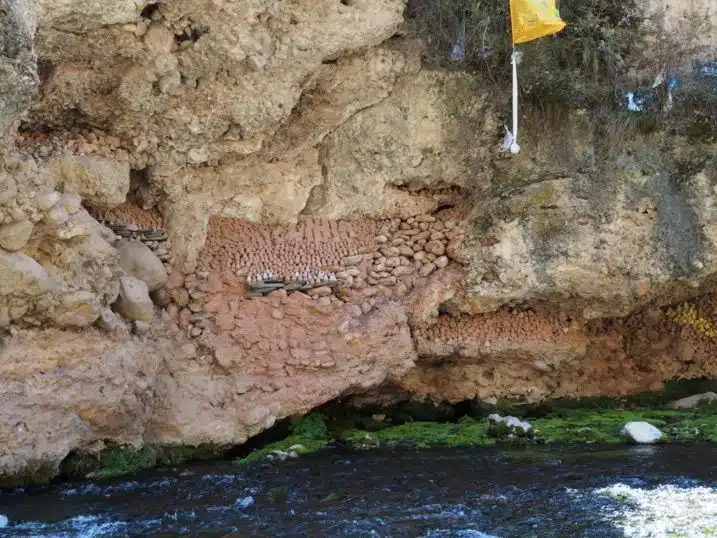
The Tertöns, or “treasure discoverers,” are regarded as manifestations of accomplished disciples who received a direct transmission from Padmasambhava in the 9th century. Their activities manifest when the appropriate time arrives for rediscovering the hidden termas. They play a central role in the renewal and vitality of the Nyingma tradition. The first Tertön, Sangyé Lama, who is considered an emanation of King Trisong Detsen, appeared in the 11th century.
The teachings revealed by these masters are not limited to the mere discovery of ancient texts or sacred objects. The rediscovered teachings are practiced, adapted, and integrated into the spiritual and cultural context of their time, while preserving “the warm breath of the one from whom they emanate.”[4] Padmasambhava effectively established the tradition of what can be described as genuine “spiritual mandates,” by prophesying the birth of the tertön and specifying not only the place but also the precise time at which the hidden teachings, or termas, were to be discovered.
As Jigme Lingpa, who holds a particularly important place today for having revealed the Longchen Nyingthig cycle, reminds us, termas were hidden and later rediscovered for four main reasons: “so that the doctrine would not disappear, so that the instructions would not be altered, so that the blessings would not weaken, and so that the lineage of transmission would be shortened.”[5]
The Terma tradition introduced a dynamic that led to an increase in the number of cycles of teachings and transmission lineages, both monastic and yogic. This diversification intensified, particularly from the 17th century onward, and expanded further in the 19th and 20th centuries, notably through the Rimé movement (Tib. ris med).
While this diversification meets the needs of sentient beings, it also implies rigorous criteria of authenticity (lineage and reference to the teachings). The short Terma lineages also rely on the validation of the teachings through the realization of the lineage holders and the direct experience of practitioners, thereby ensuring the living continuity and authenticity of the transmission.
Bibliography
Tulku Thondup Rinpoché, Les trésors cachés du Tibet. La tradition Terma de l’école Nyingma du bouddhisme tibétain, (trad. Virginie Rouanet et Philippe Cornu). Editions Guy Tredaniel, 2000.
[1] The Bön tradition in Tibet also includes Kama and Terma lineages. BACK
[2] https://dzogchentoday.org/fr/quest-ce-que-le-dzogchen-11 ; https://dzogchentoday.org/what-is-dzogchen-12/ ; https://dzogchentoday.org/what-is-dzogchen-13/ BACK
[3] “The guides contain the prophecies and instructions given to the tertöns before they discover the termas. They inform them of their status as tertöns and indicate how, where, and when the treasures were hidden and will be discovered, the person designated to support them, the holder of the doctrine, and who will be the main disciples.” (free translation) Cf. Tulku Thondup Rinpoché, Les trésors cachés du Tibet. La tradition Terma de l’école Nyingma du bouddhisme tibétain, (trad. Virginie Rouanet et Philippe Cornu). Editions Guy Tredaniel, 2000, p. 67. BACK
[4] Op. cit., Les trésors cachés du Tibet (…), p. 58. BACK
[5] Op. cit., Les trésors cachés du Tibet (…), p. 57. BACK
More Posts

The Fourth Time
In the article ” The Fourth Time ” , Johanne talks about the three times… and the fourth one, beyond time.

A Dream Life
In « A Dream Life », Grégoire wonders what the “right conditions” would be for practicing a spiritual path.

Speed-Dharma
In “Speed-Dharma,” Denis point out that, despite the impression of acceleration and “ time famine,” patience remains an essential virtue on the path.