
The Refuge and the Mountain
Written By Nils Derboule
Dzogchen Testimonials | Reflections on life
In this article, Nils explores how the mountains remind us of our human condition, and what refuge can mean in the Dzogchen tradition.
Series: Summer in the Mountains
The Refuge and the Mountain
We were on a day hike in the Swiss Alps with my parents and my three brothers, and on the way down we took the wrong path.
Everything would have been fine if the weather hadn’t suddenly turned and it hadn’t started raining.
Picture it: a family lost in a storm on a mountain, leaving the open views of the alpine meadows to plunge into the forest with no idea where it was headed. Four children (two aged four, one aged seven — me — and the eldest aged twelve), beneath branches streaming with rain, and the daylight was fading.
Yet I have no memory of being afraid. My father was surely worried, and my mother too. But me? No. I think I simply trusted.
“It is a refuge, because this primordial nature lies at the center of our whole being, of our whole existence, and because it shines like a lone dwelling in the night.”
Twenty-five years later, I found myself in the Jura at dusk, surrounded by snow, with no certainty of finding shelter before nightfall. Alone with my partner, lost in the middle of the wilderness at that peculiar hour of twilight, I felt dread creep in — the dread of a small human being without refuge, at the mercy of the vastness.
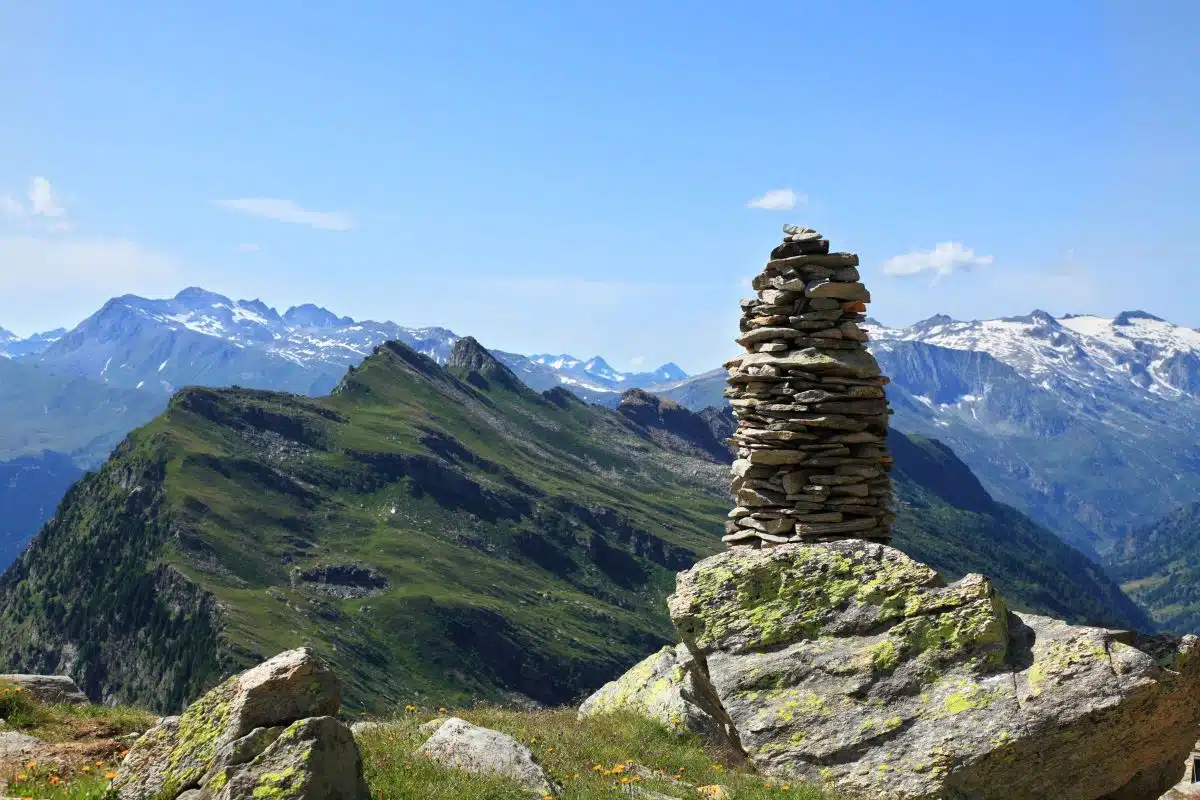
Mountains have a way of reminding us of our own finitude as human beings. Of course, when all is well and we hike the marked trails, chatting away, or speed down the paths on a mountain bike, overcoming obstacles with the thrill of adventure and complete control of our vehicle, we can be under the illusion that we are invincible. Immortal, even.
But then, when a squall rolls in and we realize we’ve lost our way and night falls all at once, our perception changes utterly. Here we are, flung from a lighthearted carelessness into the gravity of our own mortality. What if we found ourselves stuck here in the cold and the dark of night? What if a foot, or a tire, slipped into a ravine?
From then on, we try to reassure ourselves. In vain: once the feeling takes hold, nothing can undo it. The only way to regain any peace is to get ourselves out of the bad spot. For now. Or else to take refuge in something greater than ourselves.
This is precisely the foundation of the path of the Great Perfection. A tradition which, like all the great traditions of humanity, begins from an incontrovertible observation: every human being is born, and will therefore die. Throughout life, we can find temporary refuge from this innate knowledge that never leaves us. But it takes only a trip to the mountains — even without danger, just the sight of the majesty, the raw earthly power of these masses of rock — to remind us of the reality of our human condition.

In truth, there is only one innate refuge: that of our fundamental nature, which we can sometimes approach in daily life and which the path of Dzogchen proposes to realize fully.
Once completely recognized — what the Great Perfection calls the introduction to the nature of mind — this primordial nature becomes our refuge. It is a refuge, because it lies at the center of our whole being, of our whole existence, and because it shines like a lone dwelling in the night. So we naturally return to it, like a child lost on market day returns to the shelter of his mother. Is is a refuge, because the mind can neither grasp nor comprehend it, which lends it a quality that is immutable and timeless, beyond the reach of every passing emotion and every fleeting belief. It is a refuge, because it is as indestructible as a diamond, and because nothing and no one — not even ourselves — can scratch it.
Upon our first contact with our primordial nature, we experience all this directly. Repeating this encounter again and again allows us to surrender to it each time with the same trust that a seven-year-old child lost in the mountains places in his parents…
…rather like my little family adventure in the Swiss Alps where, soaked and with night fallen, we finally came upon a house along the way, lived in by a very kind couple who offered us dry, warm shelter… along with a blueberry tart fresh out of the oven.
More Posts
Manifestation
In this article, Paul defines manifestation as the play of emptiness of the All-Excellent free from partial grasping.

Crossing the Pass
In “Crossing the Pass”, Maréva explores the symbolism of crossing mountain passes in the Himalayas and in the West, and its connection to the practitioner’s path.
Is the Marmot a Yogi?
In “Is the Marmot a Yogi?”, Damien outlines a definition of what a yogī might be according to the Dzogchen tradition. Series: Summer in the...