
Termas in the World Today
Written By Mila Khyentse
Blog | Culture and tradition
In “Termas in the World Today”, Mila Khyentse talks briefly about the Terma tradition and practice today and in the near future.
Series: Highlighting the Terma Lineages
Termas in the world today
The Terma tradition is designed to evolve constantly, to “innovate” ceaselessly in response to the different needs of people as the ages succeed one another. This, in fact, is the very principle of these teachings.
Today, the terma teaching cycles most commonly practiced are those from the 18th, 19th, and 20th centuries, and among them, the most widespread are undoubtedly those of the Longchen Nyingthig (Tib. klong chen snying thig), rediscovered by Jigme Lingpa (Tib. ‘Jigs med gling pa, 1730–1798) and the Dudjom Tersar (Tib. bdud ‘joms gter gsar), rediscovered by Dudjom Lingpa (Tib. Bdud ‘joms gling pa, 1835–1904).
“Even today, some Tertöns continue to rediscover “updates” to the dzogchen teachings imparted by Padmasambhava in the 8th century. As in every era, these rediscovered practices adapt to our needs and our understanding of the world.”
A defining feature of contemporary cycles is the complexity of their practice, which aligns well with the complexity of modern thought, from the perspective of the Great Perfection tradition. Indeed, one of the distinctive features of the Dzogchen teachings is that, as time passes since the teachings of the early patriarchs (Prahevajra, Manjushrimitra, Shri Singha, Jñanasutra), they become increasingly complex to correspond to the ever-more-complex vision of human experience of reality. In other words, the earliest Dzogchen teachings were very direct and simple, while the most recently rediscovered ones are generally more gradual and complex, with the exception of the main practices of the Great Perfection: “undoing the binding,” Trekchö (Tib. khregs gcod), and “immediate leap,” Thögäl (Tib. thod rgal).
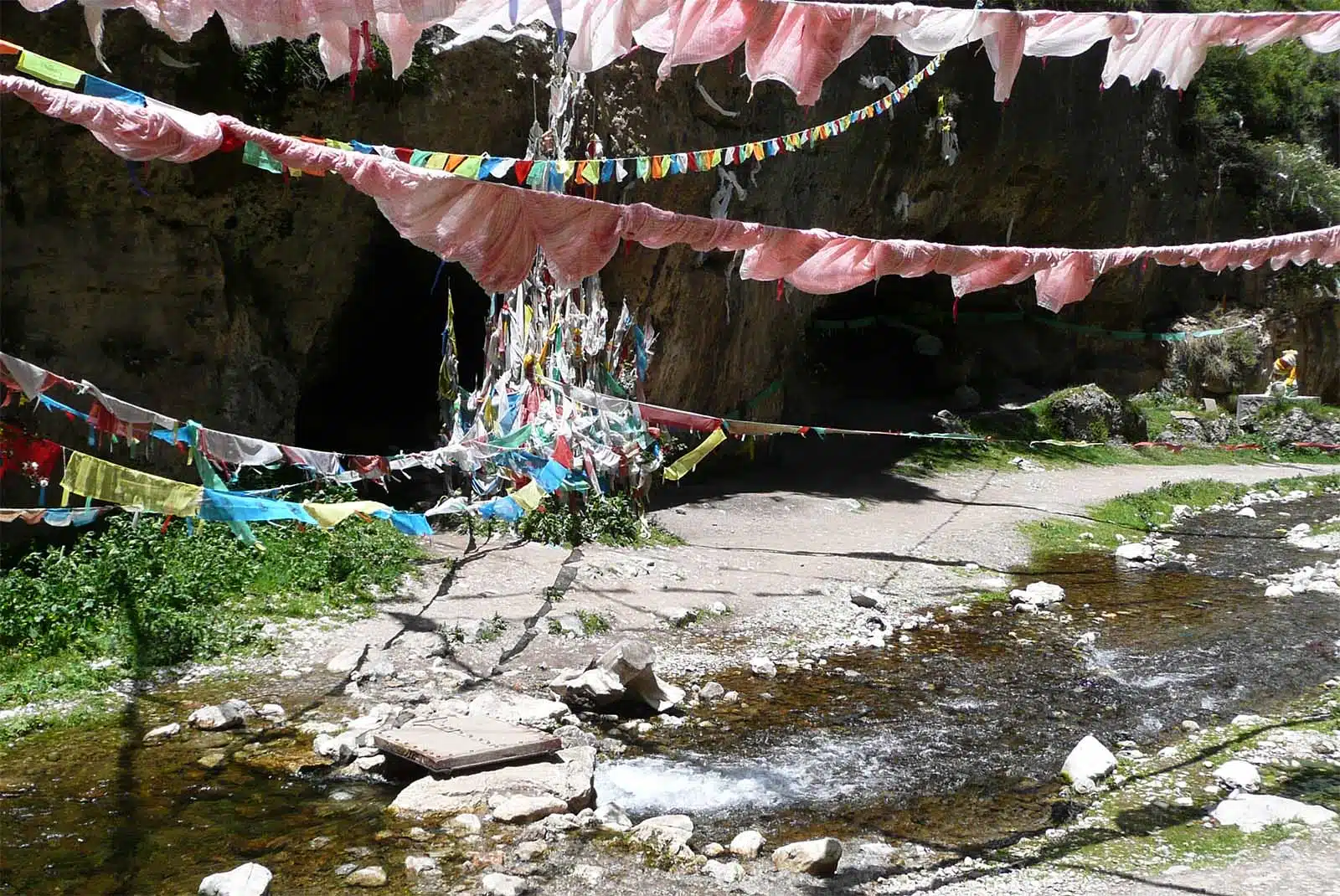
A Terma’s hidden discovery place. Taktsang Lhamo, Amdo, Eastern Tibet.
Title slide:
Alag Chörten sets off on a hunt for termas, followed by the local population. Amdo, Eastern Tibet. ca 1975.
However, some terma teachings are exceptions to the rule, such as the Longsäl cycle by Namkhai Norbu Rinpoche (Tib. Chos rgyal Nam mkha’i nor bu rin po che, 1938–2018) titled “Longchen ösel khandro Nyingthig” (Tib. klong chen ‘od gsal mkha’ ‘gro snying thig), which, although it falls within the “complex” tradition, is much more direct in its practice and the methods it emphasizes. Perfect for us in the West! We also find this simplicity in certain terma practices of contemporary Tertöns such as Jamyang Khyentse Chökyi Lodrö Rinpoche (Tib. ‘Jam dbyangs mkhyen brtse chos kyi blo gros rin po che, 1893–1959), Dilgo Khyentse Rinpoche (Tib. Dil mgo mkhyen brtse rin po che, 1910–1991), and others.
These contemporary terma teachings are widely practiced today, primarily within the Nyingma lineage, but also in other traditions of the Tibetan world. They are also widely disseminated and practiced in the West and are, in fact, becoming increasingly widespread.
Even today, some Tertöns continue to rediscover “updates” to the dzogchen teachings imparted by Padmasambhava in the 8th century. As in every era, these rediscovered practices adapt to our needs and our understanding of the world. Will we perhaps return to more direct, more immediate instructions, in keeping with the accelerating pace of our lives today? Will certain cycles in the near future be oriented toward the evolution of global living conditions on Earth in the 21st and 22nd centuries? In any case, this is to be hoped for the future of the practice of the Great Perfection and the possibilities of achieving it.
More Posts

Personal Branding: The Self in the Image
In this article, Grégoire explores whether we are our image and to what extent we can play with it to liberate ourselves.
The Story of the First Masters: Jnanasutra
The saga of the early masters of Dzogchen continues with Jñanasutra, who devoted his 500th and final life as a scholar to the practice of the Great Perfection and the attainment of the body of light.

Work as a Basis for Practice
In “Work as a Basis for Practice”, Mila Khyentse talks about working and practicing Dzogchen at the same time in the same place.