
Following a Master

Written By Maréva Bernard
General Introduction to Dzogchen
Maréva elaborates on how to follow a master, the demands but also the obviousness of this path toward the realization of primordial nature.
Series: The master-disciple relationship
Following a Master
When we meet a master, it is essential to begin with a time for observation to determine whether their teachings correspond to our search.
We listen to their teachings and pay attention to their actions, we may even spend time with them, offer them a cup of tea. However, we are still only in the observation phase.
If what he conveys does not suit us, we end up looking for other paths elsewhere. If it does, we become more and more involved. This often happens gradually, sometimes without us even realising it. We then develop real trust in the master, the teaching, the lineage, the path, and our ability to follow it.
Then we realize that the teacher has become “our” teacher when we are ready to follow his or her instructions no matter what.
“…the master is never a master on his own, but a master in relation to our needs. He shows us both our obstacles and our liberation.”
This does not mean that we will fearlessly follow him along the path, or even without hesitation at times, but what characterizes this bond now is the absence of doubt that this is the right thing to do and the absence of hesitation in sharing our doubts with him. At that moment, all our interactions become sources of teaching, because our mind is focused on awakening and our heart is filled with devotion. The patience he shows to his disciples is a source of inspiration for the patience we must cultivate towards ourselves, our path and others; the vows we take with him are a source of essential reminders in our daily lives; his instructions on how to observe our mind are gems to be cultivated at every moment.
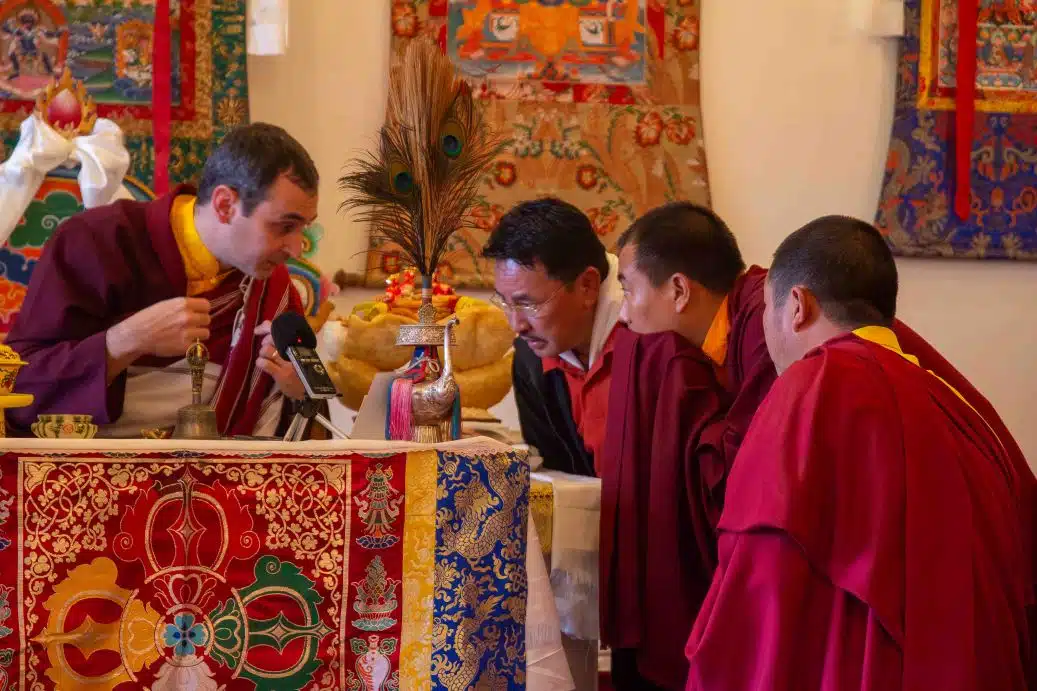
This training is demanding, and our teacher could inspire fear, respect, and love in us all at once. Because we know that he will be soothing when we need it, but also wrathful when needed to ‘readjust’ our path. And the further we advance on the path, the more refined the instructions will become as our vision clears.
It is not a gage.
It is not a challenge to be overcome.
Rather, it is the progressive meaning of the path.
Sometimes we feel that our master is showing us the result while we search for the path. In reality, he shows us the result in a thousand and one ways, so that we may follow our own path. The authenticity of our bond guarantees that his instructions will always be the right ones for us. Because in this non-judgmental relationship, we can no longer hide.
If we have a doubt, let’s express it.
If we have an aspiration, let’s share it.
If we have broken a pratice vow, let’s confess it.
If we don’t understand an instruction, let’s question our master.
And let us seize every opportunity to refine our understanding of the nature of the mind and the conditions for our enlightenment, for the teacher reflects our deluded tendencies and our nature simultaneously. It is this reflection that gives us an opportunity for recognition and allows us to move forward.
In this tradition, six types of teachers are presented: the general teacher, the one who gives initiations and samayas, the one who allows the restoration of vows, the one who gives crucial instructions, the one who liberates the mind, and the one who guides. At every moment on the path, we will need one of these qualities, so that the relative and ultimate aspects come together.
For the master is never a master on his own, but a master in relation to our needs. He shows us both our obstacles and our liberation. He acts like us, but in a completely different way. He may have his favourite dishes and habits, even though everything has a unique flavour for him. Through contact with him, we can train ourselves to make offerings with the right intention. From his point of view, everything is always correct. From ours, we can train our vigilance by observing his actions and the way he carries them out, as so many means offered to us to walk our path.
We then recognize that the master’s actions are always an expression of Thugje (Tib. thugs rje), great compassion.
In fact, the main characteristic of the master is that he is nothing other than the reflection of the primordial nature for us. In Dzogchen, he is the link that is indispensable for us to discover, realize and maintain the primordial nature of mind.
For this, blessing must meet devotion, the aspiration of the practitioner. When they meet, no questions remain: we have found our master and established a deep connection. We then follow him unwaveringly to enlightenment, for the benefit of all beings.
More Posts

Personal Branding: The Self in the Image
In this article, Grégoire explores whether we are our image and to what extent we can play with it to liberate ourselves.
The Story of the First Masters: Jnanasutra
The saga of the early masters of Dzogchen continues with Jñanasutra, who devoted his 500th and final life as a scholar to the practice of the Great Perfection and the attainment of the body of light.

Work as a Basis for Practice
In “Work as a Basis for Practice”, Mila Khyentse talks about working and practicing Dzogchen at the same time in the same place.